DFIN100 · COMPLETE TEACHING DRAFT FOR ACADEMIC REVIEW

Personal Finance in the Digital Age

Build a practical financial decision process for earning, spending, borrowing, saving, investing, and managing risk in a digital environment. Compare costs and terms, evaluate financial information, and recognize scams and privacy risks. Develop a financial resilience plan for a fictional household. Assessment rewards reasoning and verification rather than income, wealth, or disclosure of personal circumstances.

16 modules48 lessonsNo academic credit500 sample points

No academic credit awarded. Sample grading guidance totals 500 points. Quizzes are browser practice; assignments, case reviews, and the capstone require human review.

How this course is designed to help you learn

Predict before reading. Study a worked example, explain the method, try a problem, and retrieve the ideas without notes. Revisit earlier modules over several sessions. Use confidence ratings to choose what to review; check performance rather than judging familiarity alone.

  • Module roadmap: Preview the sequence, time, and objectives. Advance organizers and clear signaling reduce extraneous load and help you connect new ideas to a structure (Mayer, 2021).
  • Make a prediction: Answer one question before the lessons. Pretesting improves later learning of the tested content, even after an error, if feedback follows (Richland et al., 2009; Pan & Carpenter, 2023).
  • Retrieval check after each lesson: Answer from memory, then read the explanation. Practice testing is among the most effective study methods; explanatory feedback corrects errors (Roediger & Karpicke, 2006; Dunlosky et al., 2013; Hattie & Timperley, 2007).
  • New diagrams with text descriptions: Study the picture and its words together. Words with related graphics support deeper understanding than words alone; text descriptions keep the content accessible (Mayer, 2021; CAST, 2024).
  • Watch for these errors: Compare a common error with better reasoning. Refutation text that names and corrects a misconception changes understanding more than explanation alone (Tippett, 2010).
  • Your turn / Draw to learn: Complete a faded problem or sketch from memory. Fading worked-example steps and generative drawing build independent skill (Renkl & Atkinson, 2003; Fiorella & Mayer, 2016).
  • Explain it in your own words: Write a short causal explanation. Self-explanation and elaborative questioning improve transfer (Chi et al., 1994; Dunlosky et al., 2013).
  • Spaced review: Answer questions from earlier modules. Distributed and interleaved practice improves retention and method selection (Cepeda et al., 2006; Rohrer & Taylor, 2007).
  • Close the module: Free recall, confidence rating, muddiest point. Self-monitoring and calibration support self-regulated learning and better restudy choices (Zimmerman, 2002; Bjork et al., 2013).
Research informing the learning design
  • Bjork, R. A., Dunlosky, J., & Kornell, N. (2013). Self-regulated learning: Beliefs, techniques, and illusions. Annual Review of Psychology, 64, 417-444.
  • CAST. (2024). Universal Design for Learning Guidelines version 3.0. https://udlguidelines.cast.org
  • Cepeda, N. J., Pashler, H., Vul, E., Wixted, J. T., & Rohrer, D. (2006). Distributed practice in verbal recall tasks: A review and quantitative synthesis. Psychological Bulletin, 132(3), 354-380.
  • Chi, M. T. H., de Leeuw, N., Chiu, M.-H., & LaVancher, C. (1994). Eliciting self-explanations improves understanding. Cognitive Science, 18(3), 439-477.
  • Dunlosky, J., Rawson, K. A., Marsh, E. J., Nathan, M. J., & Willingham, D. T. (2013). Improving students’ learning with effective learning techniques. Psychological Science in the Public Interest, 14(1), 4-58.
  • Fiorella, L., & Mayer, R. E. (2016). Eight ways to promote generative learning. Educational Psychology Review, 28(4), 717-741.
  • Freeman, S., Eddy, S. L., McDonough, M., et al. (2014). Active learning increases student performance in science, engineering, and mathematics. PNAS, 111(23), 8410-8415.
  • Hattie, J., & Timperley, H. (2007). The power of feedback. Review of Educational Research, 77(1), 81-112.
  • Mayer, R. E. (2021). Multimedia Learning (3rd ed.). Cambridge University Press.
  • Pan, S. C., & Carpenter, S. K. (2023). Prequestioning and pretesting effects: A review of empirical research, theoretical perspectives, and implications for educational practice. Educational Psychology Review, 35, 97.
  • Renkl, A., & Atkinson, R. K. (2003). Structuring the transition from example study to problem solving in cognitive skill acquisition. Educational Psychologist, 38(1), 15-22.
  • Richland, L. E., Kornell, N., & Kao, L. S. (2009). The pretesting effect: Do unsuccessful retrieval attempts enhance learning? Journal of Experimental Psychology: Applied, 15(3), 243-257.
  • Roediger, H. L., & Karpicke, J. D. (2006). Test-enhanced learning: Taking memory tests improves long-term retention. Psychological Science, 17(3), 249-255.
  • Rohrer, D., & Taylor, K. (2007). The shuffling of mathematics problems improves learning. Instructional Science, 35(6), 481-498.
  • Sweller, J., van Merriënboer, J. J. G., & Paas, F. (2019). Cognitive architecture and instructional design: 20 years later. Educational Psychology Review, 31, 261-292.
  • Tippett, C. D. (2010). Refutation text in science education: A review of two decades of research. International Journal of Science and Mathematics Education, 8(6), 951-970.
  • Zimmerman, B. J. (2002). Becoming a self-regulated learner: An overview. Theory Into Practice, 41(2), 64-70.
COURSE SYLLABUS

Learn to support a decision with evidence

Build a practical financial decision process for earning, spending, borrowing, saving, investing, and managing risk in a digital environment. Compare costs and terms, evaluate financial information, and recognize scams and privacy risks. Develop a financial resilience plan for a fictional household. Assessment rewards reasoning and verification rather than income, wealth, or disclosure of personal circumstances.

What you will be able to do

  1. Construct a household cash flow budget and net worth statement using consistent categories and dates.
  2. Set measurable goals and evaluate emergency saving and irregular-income strategies.
  3. Compare banking, payment, credit, and loan products using total cost, timing, and stated terms.
  4. Calculate compound growth, borrowing costs, and repayment alternatives under explicit assumptions.
  5. Explain diversification, investment fees, risk, and retirement planning without assuming guaranteed returns.
  6. Evaluate insurance, employment benefits, and tax information with attention to jurisdiction and source date.
  7. Recognize fraud, privacy risks, misleading financial claims, and limitations of AI tools.
  8. Create and revise an evidence-supported financial resilience plan for a realistic synthetic household.

Preparation and audience

No formal prerequisite is proposed. Basic arithmetic, reading, and introductory spreadsheet skills are recommended. Worked examples and calculator or accessible text alternatives are provided. Learners need no bank, brokerage, credit, cryptocurrency, or paid budgeting account. This is proposed as an introductory higher education or noncredit professional course.

Higher education learners and corporate and professional learners seeking practical financial capability

Sample grading criteria

Potential distribution of 500 sample points
AssessmentDistributionPotential pointsWeight
Module checkpoints16 × 5 points8016%
Applied labs or studios8 × 15 points12024%
Evidence discussions6 × 10 points6012%
Module 8 case review3 × 30 points9018%
Final capstoneIntegrated final submission15030%
Total500100%

Course percentage = accrued reviewed points ÷ 500 × 100. Apply cutoffs to the unrounded percentage. Fractional reviewed points are allowed; ranges use an exclusive upper bound to avoid gaps. A checkpoint practice subtotal is not a final course grade.

Sample letter grade scale confirmed by the course owner
GradePercentageAccrued points
A95–100%475–500
A−90–<95%450–<475
B+85–<90%425–<450
B80–<85%400–<425
B−75–<80%375–<400
C70–<75%350–<375
FailureBelow 70%0–<350

Final project

A final integrated project is included in the sample grading plan. Sign in to review the detailed assignment and assessment guidance.

Capstone rubric totaling 150 sample points
CriterionPotential pointsExpected evidence
Records and quantitative accuracy37.5Transactions reconcile; transfers are consistent; budget, net worth, interest, and fees are correct.
Goals and decision tradeoffs30Goals are measurable; product and repayment choices fit the fictional circumstances.
Risk and long-term planning30Insurance and saving choices consider uncertainty, fees, liquidity, and household shocks.
Digital safety and source checks30Plan protects privacy, identifies misleading claims, and uses dated authoritative sources.
Communication revision and action22.5Plan is clear, gives feasible next steps, credits sources, and explains revisions.

Course policies

Credit and sample grades

No academic credit, official grade, transcript, continuing education unit, or professional certification is awarded. The 500-point framework and letter scale are sample grading guidance. Auto-scored checkpoint practice is separate from work requiring human review. Unreviewed work never receives invented instructor points.

Pacing and workload

Sixteen modules with a suggested 16-week sequence, or eight weeks pairing successive modules. Plan about 135 total learning hours including reading, practice, modeling, and the capstone. This is a study estimate, not assigned credit or verified contact hours. Suggested dates do not lock self-paced access.

Public and signed-in access

Modules 1 and 2 are public. Modules 3 through 16 require an active verified Deneb sign-in. The desktop review package contains the complete authorized draft. Public course responses and downloads contain only public teaching content. Signing in does not grant faculty or administrator privileges.

Materials and tools

Use linked free publisher readings, a browser, and a way to save work. Deneb provides its existing embedded McNova Docs, Sheets, Presentations, and PDF editors. Links open the current workspace.mcpleni.com versions, Equations, and Drawing separately. Tool versions can differ. Export before switching; storage and sign-in are separate, and no automatic transfer or grade synchronization is claimed.

Practice records

Checkpoint answers, notes, and completion markers are browser practice records. They are not server-submitted coursework or a verified transcript. Signed-in practice uses an account-specific opaque storage scope. Export records before clearing storage or changing devices. Public practice is not silently merged into an account.

Feedback and integrity

Five untimed one-point questions per module, up to three recorded browser attempts, best score retained, and explanations after submission. This is formative study, not a secure examination. In a facilitated offering an instructor must publish contacts, deadlines, feedback expectations, late work and appeals before enrollment.

AI and privacy

Try calculations independently. AI may explain terminology, suggest a study plan, or help edit a draft when disclosed. Verify arithmetic and claims against the course and cited sources. Never invent evidence or upload patient, student, employer, bank, or credential information. All datasets are synthetic.

Accessibility

Lessons are text-first. Original diagrams include text descriptions and tables; calculators provide labeled inputs and readable results. Quizzes are untimed. Written alternatives are available for spoken briefings, and a spreadsheet can be replaced by equivalent calculation tables. Report barriers to the adopting instructor or service@nelyant.com.

Review and scope

Academic and subject-matter review remains pending. The course is management education, not personalized investment, tax, accounting compliance, or legal advice. Rates and tax inputs are labeled hypothetical; current regulations and reporting frameworks need dated specialist review in an adopted course.

Context

Educational examples use synthetic information and USD. Official US resources illustrate source verification; institutions outside the US must adapt jurisdiction-specific requirements with qualified local review.

Sources and further reading

Lesson text, examples, datasets, questions, and diagrams are original to this draft. Publisher readings are linked rather than reproduced. Supplied editions have varying reuse terms; exact-edition and figure exclusions require review before copying any textbook asset.

MODULE 1 · PUBLIC PREVIEW

Financial wellbeing values and goals

Write a measurable financial goal and distinguish a personal priority from a marketing claim.

Learning outcomes 2, 7, 8 · Selected reading C wellbeing and goal setting tools; P goals assignment

Reasoning sequence for Financial wellbeing values and goalsRecordsReconcileInterpretDecide
Original concept map for Financial wellbeing values and goals. Teaching sequence: Records → Reconcile → Interpret → Decide. The labels summarize reasoning rather than measured data; quantitative results appear in the worked examples and model tables.

Module roadmap

Turn a personal priority into a dated, measurable goal and test whether the monthly contribution fits the cash you actually have.

Suggested study time: 120 minutes, plus assessment and independent practice. Follow the lessons in order, retrieve the ideas, then apply and review.

Before you start: make a prediction

A learner wants $900 saved in 9 months, has nothing set aside yet, and has a $75 monthly surplus. What do you predict?

Choose an answer, then compare your reasoning
Check your reasoning (unscored)

The plan needs $100 a month, so it falls $25 short each month. $900 divided by 9 months is $100 a month. A $75 surplus leaves a $25 monthly gap, or $225 over nine months. Being close is not the same as fitting; the goal needs a later date, a smaller amount, or more resources.

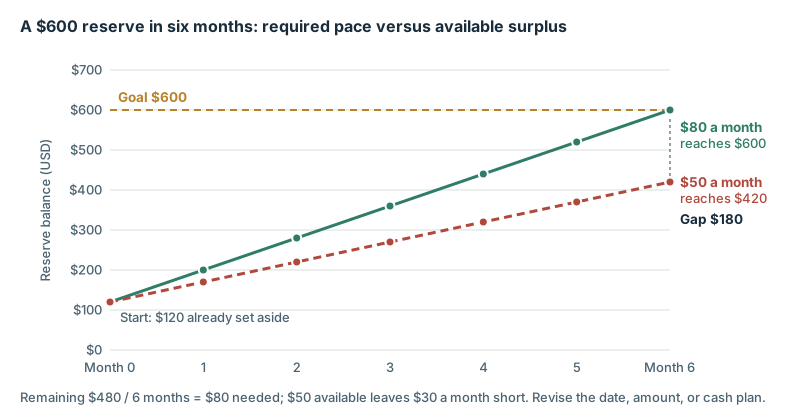
Line chart over months 0 to 6. The goal line is at $600. The required plan starts at $120 and adds $80 each month: $200, $280, $360, $440, $520, $600. The available plan adds $50 each month: $170, $220, $270, $320, $370, $420. At month 6 the gap is $180, which is $30 a month. All figures are synthetic and assume no interest or withdrawals.
A $600 reserve goal: required pace versus available surplus — Synthetic goal timeline. With $120 already saved, $80 a month reaches the $600 goal in six months; the available $50 a month reaches $420, a $180 gap ($30 a month). Original course illustration.
LESSON 1.1 · 20 MINUTES PLUS PRACTICE

Understand the decision: Connect goals, values and financial wellbeing

Personal finance is a process of directing limited resources toward needs, obligations, and goals under uncertainty. Income, wealth, cash flow, and financial wellbeing describe different things. A person may have a positive balance sheet but little accessible cash, or modest income with a stable buffer. Start with priorities and constraints rather than comparing yourself with an influencer’s lifestyle. Digital tools can organize information, but they cannot decide which tradeoffs fit an individual household.

Worked example

A synthetic learner wants a $600 reserve in six months and already has $120 dedicated to it. The remaining $480 requires $80 per month if there is no interest or withdrawal. If the monthly surplus is only $50, the gap is $30; the learner must revise the goal or the cash plan rather than assume the app will create the difference.

Sam has $35,000 of home equity but $150 in checking. Ari has no home but $2,000 in an accessible savings account. Which statement is accurate?

Choose an answer, then compare your reasoning
Check your reasoning (unscored)

Net worth and accessible cash measure different things, so Ari may handle a $500 repair more easily. Net worth is a stock measured at a date; accessible cash is what can pay a bill next week. Sam's equity is real wealth but is slow and costly to turn into cash, so higher net worth does not mean more available money.

Apply the idea

Create three synthetic goals, distinguish cash-flow and balance-sheet measures, and test one contribution schedule against available resources. Explain your assumptions, independently check a result, and record what would change your conclusion.

LESSON 1.2 · 20 MINUTES PLUS PRACTICE

Apply a transparent method: Connect goals, values and financial wellbeing

Write a goal with a purpose, amount, target date, and review point. Distinguish needs, wants, and commitments without assuming every household has the same flexibility. Convert the goal into a periodic contribution and test whether it fits a cash-flow plan. Use synthetic figures in class. Keep private account numbers, identifying information, and credentials out of shared documents and AI tools.

Worked example

Step 1, write the goal: a synthetic household wants a $1,500 car-repair fund in 10 months, reviewed at month 5. Step 2, subtract what exists: $300 is already set aside, leaving $1,200. Step 3, convert to a contribution: $1,200 divided by 10 is $120 a month. Step 4, test it against cash: the monthly surplus is $140, so the contribution fits with $20 to spare. Step 5, set the checkpoint: at month 5 the fund should hold $300 plus $600, or $900.

A goal is $1,200 in 8 months, and $400 is already set aside for it. What monthly contribution does the goal require, with no interest or withdrawals?

Choose an answer, then compare your reasoning
Check your reasoning (unscored)

$100 a month. Subtract what is already saved first: $1,200 minus $400 leaves $800, and $800 divided by 8 is $100. Dividing the full $1,200 by 8 gives $150, which ignores the money already set aside.

Apply the idea

Create three synthetic goals, distinguish cash-flow and balance-sheet measures, and test one contribution schedule against available resources. Explain your assumptions, independently check a result, and record what would change your conclusion.

LESSON 1.3 · 20 MINUTES PLUS PRACTICE

Evaluate and revise: Connect goals, values and financial wellbeing

Evaluate a goal by feasibility and resilience rather than ambition alone. If the required contribution exceeds available cash, revise timing, amount, resources, or other spending. A budget is a decision aid that can change as circumstances change. Review progress with compassion and evidence; a missed target is information about the plan, not a complete judgment about a person.

Worked example

A synthetic learner's plan says: save $2,400 in 6 months. That requires $400 a month, but the monthly surplus is $250, a $150 gap. The plan fails the feasibility test, not the learner. Two honest revisions: keep $2,400 and extend to 10 months, since $250 times 10 is $2,500; or keep 6 months and lower the goal to $1,500, since $250 times 6 is $1,500. The learner picks one, records why, and sets a review date.

A plan needs $100 a month for 8 months, but the cash plan shows only $70 a month available. Which revision is most realistic?

Choose an answer, then compare your reasoning
Check your reasoning (unscored)

Extend the date to about 12 months or lower the amount, and record why. $800 remaining at $70 a month takes about 11.4 months, so 12 months works. A missed target is information about the plan. Borrowing to fill a savings goal adds a cost and an obligation without solving the cash gap.

Apply the idea

Create three synthetic goals, distinguish cash-flow and balance-sheet measures, and test one contribution schedule against available resources. Explain your assumptions, independently check a result, and record what would change your conclusion.

GUIDED PRACTICE · UNGRADED

Guided practice: Connect goals, values and financial wellbeing

All amounts and observations below are synthetic. Currency is USD unless stated otherwise. Do not submit real personal, patient, employer, or bank records.

Synthetic module dataset
Case componentSynthetic teaching record
ScenarioA synthetic learner wants a $600 reserve in six months and already has $120 dedicated to it. The remaining $480 requires $80 per month if there is no interest or withdrawal. If the monthly surplus is only $50, the gap is $30; the learner must revise the goal or the cash plan rather than assume the app will create the difference.
TaskCreate three synthetic goals, distinguish cash-flow and balance-sheet measures, and test one contribution schedule against available resources.
Evidence statusFictional classroom data; no actual client, patient or account records
  1. Create three synthetic goals, distinguish cash-flow and balance-sheet measures, and test one contribution schedule against available resources.
  2. Show calculations or a reproducible evidence trail with a date, units, and source or assumption labels.
  3. Develop one downside or contradictory-evidence case. Explain its practical implication.
  4. Submit a workbook or evidence table and a 300–500-word decision brief, with an accessible equivalent of any visual.

Submit the calculation or evidence table, the brief, and a revision log. An instructor reviews the rubric; the page does not assign a manual grade.

Compare with the worked guidance

A synthetic learner wants a $600 reserve in six months and already has $120 dedicated to it. The remaining $480 requires $80 per month if there is no interest or withdrawal. If the monthly surplus is only $50, the gap is $30; the learner must revise the goal or the cash plan rather than assume the app will create the difference. A strong answer also identifies omitted conditions, checks the method, and defends a feasible next step.

Attempt your own response before opening this guidance. Compare methods and assumptions, then record a revision.

Discussion 1 Evidence discussion

Create three synthetic goals, distinguish cash-flow and balance-sheet measures, and test one contribution schedule against available resources. Present the strongest objection to your recommendation and respond using the evidence and limitations.

Write 200 to 300 words using a course source or case record, then respond with a reasoned question or counterargument. In solo study, write the strongest counterargument yourself. Do not publish confidential information.

Discussion rubric totaling 10 points
CriterionSample points
Supported analysis4
Source or case evidence3
Response or counterargument2
Clarity respect and attribution1

Watch for these errors

Claim to examine: A big goal shows commitment, so the plan should keep it even when the numbers do not fit.

A goal is useful only when its monthly contribution fits real cash flow. Changing the date or amount is a planning decision, not giving up.

Claim to examine: Net worth tells you whether you can pay next month's bills.

Net worth can be positive while accessible cash is near zero. Check cash flow and accessible balances separately from net worth.

Your turn: Convert a goal into a monthly plan

A synthetic student wants an $1,800 laptop and emergency fund in 12 months. Work through the plan with no interest or withdrawals.

  • Goal amount: $1,800
  • Already set aside: $360
  • Time: 12 months
  • Monthly surplus available: $95

Compare with the solution

$1,800 minus $360 is $1,440. $1,440 divided by 12 is $120 a month. $120 minus $95 is a $25 gap. At $95 a month, $1,440 takes 15.2 months, so 16 whole months. The student can extend the date to 16 months, lower the amount, or change spending; each choice is a tradeoff to record.

Explain it in your own words

Why should a financial goal include an amount, a date, and a review point rather than only a purpose like 'save more'?

Compare with a model explanation

An amount and a date let you convert the goal into a monthly contribution, and that number can be tested against the cash you actually have. Without them, you cannot tell whether the plan is feasible or whether you are on track. A review point lets you catch a gap early and revise the date, amount, or spending while there is still time. A purpose alone motivates, but it gives no way to check progress or notice that the plan needs to change.

Close the module

Without notes, write the steps for turning a goal into a monthly contribution and the test that shows whether it fits.

For each lesson, rate confidence from 1 (need help) to 5 (can explain independently). Check that judgment against a fresh question. Identify your muddiest point and schedule a review in two days and again next week.

All activities in this section are unscored and do not change checkpoint grades.

Module 1 checkpoint

Five questions · 5 practice points · untimed · three attempts, best retained. Complete every question before submitting. This is formative practice; feedback is available after submission.

1. $600 goal less $120 already saved leaves?
2. $480 divided over six months requires?
3. If available surplus is $50, the monthly gap is?
4. Which is a stock measured at a date?
5. What belongs in a class finance file?

MODULE 2 · PUBLIC PREVIEW

Income spending and transaction tracking

Classify four weeks of synthetic transactions and avoid double counting transfers and cash withdrawals.

Learning outcomes 1, 2, 8 · Selected reading P tracking assignment; C spending and cash flow tools

Reasoning sequence for Income spending and transaction trackingRecordsReconcileInterpretDecide
Original concept map for Income spending and transaction tracking. Teaching sequence: Records → Reconcile → Interpret → Decide. The labels summarize reasoning rather than measured data; quantitative results appear in the worked examples and model tables.

Module roadmap

Reconcile a month of transactions and report spending without counting transfers or card payments twice.

Suggested study time: 120 minutes, plus assessment and independent practice. Follow the lessons in order, retrieve the ideas, then apply and review.

Before you start: make a prediction

You are paid $1,800 take-home and later move $250 from checking to your own savings account. How much new income arrived this month?

Choose an answer, then compare your reasoning
Check your reasoning (unscored)

$1,800. Only the paycheck is new income. Moving $250 between your own accounts is a transfer: checking falls and savings rises by the same amount, so your total resources do not change.

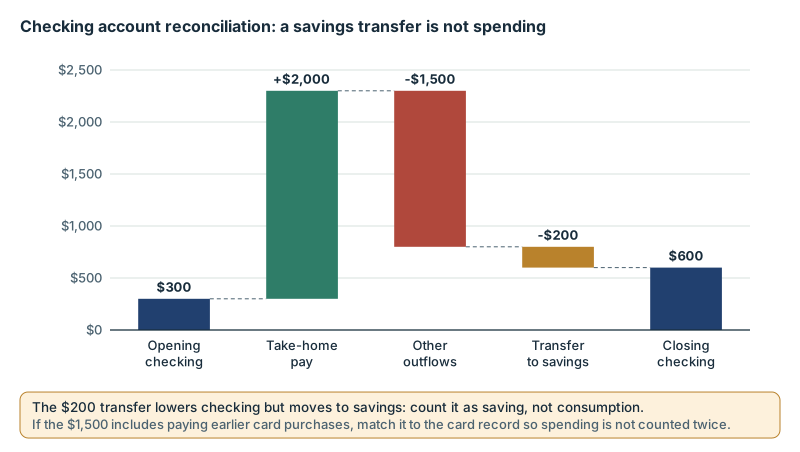
Waterfall chart. Opening checking cash $300. Take-home pay adds $2,000. Other outflows subtract $1,500. A transfer to savings subtracts $200 from checking. Closing checking cash is $600, which reconciles: 300 + 2,000 - 1,500 - 200 = 600. The transfer is shown in amber because it is saving rather than spending. All figures are synthetic.
Checking reconciliation with a savings transfer — Synthetic month: opening checking $300, take-home pay $2,000, other outflows $1,500, transfer to savings $200, closing checking $600. Original course illustration.
LESSON 2.1 · 20 MINUTES PLUS PRACTICE

Understand the decision: Track income and spending without double-counting

A transaction record explains where money came from and where it went during a defined period. Separate gross pay from take-home pay, purchases from transfers, and bills from debt balances. Moving money between your own accounts is a transfer, not new income. A credit-card purchase creates spending and a liability; a later card payment settles that liability and should not count the same purchase as consumption again. Consistent categories make the record useful for decisions.

Worked example

Synthetic opening checking cash is $300; take-home pay is $2,000; cash outflows total $1,700, including a $200 transfer to savings. Closing checking cash is $600. The transfer reduces checking but is not consumption. If the $1,500 other outflows include settlement of earlier card purchases, category spending still needs a separate timing reconciliation.

On Monday you buy $60 of groceries with a credit card. On Friday you pay the $60 card bill from checking. How much grocery spending happened this week?

Choose an answer, then compare your reasoning
Check your reasoning (unscored)

$60. The purchase on Monday is the spending; it also creates a $60 liability. The Friday payment settles that liability. Counting both gives $120, which double-counts the same groceries.

Apply the idea

Classify and reconcile a synthetic transaction file, showing transfers separately and explaining how you prevent double-counted card spending. Explain your assumptions, independently check a result, and record what would change your conclusion.

LESSON 2.2 · 20 MINUTES PLUS PRACTICE

Apply a transparent method: Track income and spending without double-counting

Choose a period and reconcile opening cash plus inflows minus outflows to closing cash. Identify timing differences, pending transactions, refunds, and fees. Use a separate view for spending categories so transfers and liability settlement do not distort consumption totals. Record the source of each synthetic entry and flag unclear classifications instead of silently guessing. Reconcile before interpreting an app’s colorful chart.

Worked example

A synthetic month opens with $520 in checking. Inflows: $2,100 take-home pay and a $40 refund, $2,140 in total. Outflows: $950 rent, $310 groceries, $150 transfer to savings, $220 card payment for last month's purchases, and $90 phone, $1,720 in total. Closing cash is $520 plus $2,140 minus $1,720, or $940, which matches the bank. For the spending view, count rent, groceries, and phone: $1,350. The transfer and the card payment move money but are not this month's consumption.

Opening checking cash is $450. Inflows are $1,900 and outflows are $1,620. What should the closing balance be?

Choose an answer, then compare your reasoning
Check your reasoning (unscored)

$730. Opening cash plus inflows minus outflows: $450 plus $1,900 minus $1,620 is $730. If the bank shows a different number, look for pending items, fees, or a missed entry before trusting any chart.

Apply the idea

Classify and reconcile a synthetic transaction file, showing transfers separately and explaining how you prevent double-counted card spending. Explain your assumptions, independently check a result, and record what would change your conclusion.

LESSON 2.3 · 20 MINUTES PLUS PRACTICE

Evaluate and revise: Track income and spending without double-counting

Judge a tracking method by completeness, clarity, and the effort needed to maintain it. Automatic categorization can mislabel a transfer or split purchase. A record that is easy to review regularly may be more useful than a complex dashboard that is never reconciled. Retain a private correction log and export a copy so access does not depend on one app or device.

Worked example

A synthetic budgeting app reports 'You spent $2,050 this month.' Checking the list shows it counted a $400 transfer to savings and a $250 card payment for purchases already counted last month. Corrected consumption is $2,050 minus $400 minus $250, or $1,400. The learner adds two rules to the correction log, marks savings transfers and card payments as non-spending, and exports a copy of the corrected file so the record does not depend on one app.

Your banking app labels a $300 transfer to your own savings as 'Shopping'. What is the best response?

Choose an answer, then compare your reasoning
Check your reasoning (unscored)

Reclassify it as a transfer and note the correction in your log. Automatic categories can mislabel transfers. Leaving it overstates spending by $300, and deleting it breaks the reconciliation. A correction log keeps the record accurate and shows what you changed.

Apply the idea

Classify and reconcile a synthetic transaction file, showing transfers separately and explaining how you prevent double-counted card spending. Explain your assumptions, independently check a result, and record what would change your conclusion.

APPLIED LAB · 15 SAMPLE POINTS · HUMAN REVIEW

Applied studio: Track income and spending without double-counting

All amounts and observations below are synthetic. Currency is USD unless stated otherwise. Do not submit real personal, patient, employer, or bank records.

Synthetic module dataset
Case componentSynthetic teaching record
ScenarioSynthetic opening checking cash is $300; take-home pay is $2,000; cash outflows total $1,700, including a $200 transfer to savings. Closing checking cash is $600. The transfer reduces checking but is not consumption. If the $1,500 other outflows include settlement of earlier card purchases, category spending still needs a separate timing reconciliation.
TaskClassify and reconcile a synthetic transaction file, showing transfers separately and explaining how you prevent double-counted card spending.
Evidence statusFictional classroom data; no actual client, patient or account records
  1. Classify and reconcile a synthetic transaction file, showing transfers separately and explaining how you prevent double-counted card spending.
  2. Show calculations or a reproducible evidence trail with a date, units, and source or assumption labels.
  3. Develop one downside or contradictory-evidence case. Explain its practical implication.
  4. Submit a workbook or evidence table and a 300–500-word decision brief, with an accessible equivalent of any visual.

Submit the calculation or evidence table, the brief, and a revision log. An instructor reviews the rubric; the page does not assign a manual grade.

Lab rubric totaling 15 points
CriterionSample points
Accuracy and evidence6
Method and traceability4
Interpretation and limitations3
Clarity and attribution2
Compare with the worked guidance

Synthetic opening checking cash is $300; take-home pay is $2,000; cash outflows total $1,700, including a $200 transfer to savings. Closing checking cash is $600. The transfer reduces checking but is not consumption. If the $1,500 other outflows include settlement of earlier card purchases, category spending still needs a separate timing reconciliation. A strong answer also identifies omitted conditions, checks the method, and defends a feasible next step.

Attempt your own response before opening this guidance. Compare methods and assumptions, then record a revision.

Watch for these errors

Claim to examine: Every dollar that leaves checking is spending.

Transfers to your own accounts and payments that settle a card balance move money without new consumption. Classify them separately.

Claim to examine: If the app shows a chart, the numbers have already been checked.

A chart only displays categories the app assigned. Reconcile opening cash, inflows, outflows, and closing cash first, then review the categories.

Your turn: Reconcile a synthetic month

Use this synthetic checking record. The card payment settles purchases already counted last month.

  • Opening cash: $380
  • Inflows: take-home pay $1,950 and a refund of $25 (counted as an inflow in this exercise)
  • Outflows: rent $900, groceries $280, transfer to savings $200, card payment $160, utilities $120

Compare with the solution

Inflows are $1,950 plus $25, or $1,975. Outflows are $900 + $280 + $200 + $160 + $120, or $1,660. Closing cash is $380 + $1,975 minus $1,660, or $695. Consumption counts rent, groceries, and utilities: $1,300. The $200 transfer and the $160 card payment are excluded from spending but included in the cash reconciliation.

Explain it in your own words

Explain why a cash reconciliation and a spending report can show different totals for the same month, and why both are useful.

Compare with a model explanation

The cash reconciliation follows every dollar in and out of the account, including transfers and card payments, so it can confirm the closing balance. The spending report counts only consumption in the period, so it leaves out transfers to your own savings and payments that settle purchases already counted. The totals differ because they answer different questions. The reconciliation catches missing or wrong entries; the spending report shows where money was actually used, which is what you need for a budget.

Spaced review

Retrieve earlier ideas before checking the feedback.

If available surplus is $50, the monthly gap is?

Choose an answer, then compare your reasoning
Check your reasoning (unscored)

$30. $30. A synthetic learner wants a $600 reserve in six months and already has $120 dedicated to it. The remaining $480 requires $80 per month if there is no interest or withdrawal. If the monthly surplus is only $50, the gap is $30; the learner must revise the goal or the cash plan rather than assume the app will create the difference.

$600 goal less $120 already saved leaves?

Choose an answer, then compare your reasoning
Check your reasoning (unscored)

$480. $480. A synthetic learner wants a $600 reserve in six months and already has $120 dedicated to it. The remaining $480 requires $80 per month if there is no interest or withdrawal. If the monthly surplus is only $50, the gap is $30; the learner must revise the goal or the cash plan rather than assume the app will create the difference.

Close the module

From memory, list three kinds of transactions that move money but should not count as new income or new spending.

For each lesson, rate confidence from 1 (need help) to 5 (can explain independently). Check that judgment against a fresh question. Identify your muddiest point and schedule a review in two days and again next week.

All activities in this section are unscored and do not change checkpoint grades.

Module 2 checkpoint

Five questions · 5 practice points · untimed · three attempts, best retained. Complete every question before submitting. This is formative practice; feedback is available after submission.

1. $300 opening plus $2,000 inflows minus $1,700 outflows gives?
2. A transfer between your own checking and savings is?
3. How should a later payment for an already recorded card purchase be treated?
4. Which pay measure is available after payroll deductions?
5. What should precede interpretation of a spending chart?

WORKSPACE.MCPLENI.COM

Your tools beside your learning

Use an embedded McNova editor here, or open the current Workspace version in a new tab. Deneb embeds a dated, reviewed copy of the Workspace tools. Workspace links always open the currently published version. Use synthetic data and save or export before switching; nothing is automatically submitted or graded.

McNova Sheets

Build budgets, ratios, amortization, and project cash flow models.

Open Workspace version

McNovaDocs

Draft management memos, evidence logs, and reflections.

Open Workspace version

McNova Presentations

Prepare an accessible decision briefing or venture pitch.

Open Workspace version

McNovaPDF Workbench

Read and annotate authorized resources and exported reports.

Open Workspace version

McNova AI Writing Pro

Develop and review an evidence brief. Use synthetic information and verify AI proposals.

Open Workspace version

McNova Speech Pro

Read aloud or prepare a reviewed transcript. Speech recognition remains a development preview.

Open Workspace version

Choose a built-in editor above to begin. In the desktop review copy, use a Workspace link or open the live course to use Deneb’s embedded editors.

Workspace apps open separately because their current security policy blocks embedding on other sites. Deneb’s existing built-in McNova editors remain available inside the live course. There is no automatic file transfer or grade synchronization.

PRIVATE BROWSER PRACTICE

Your practice record

No final course grade is calculated from incomplete or unreviewed work. The 500-point grading table is a sample framework. Practice records are editable browser data, not a verified transcript.

Quick reference

Connect goals, values and financial wellbeing
Personal finance is a process of directing limited resources toward needs, obligations, and goals under uncertainty.
Track income and spending without double-counting
A transaction record explains where money came from and where it went during a defined period.
Budget for timing and irregular income
A budget assigns expected resources to priorities over a period; a cash-flow calendar tests whether money is available on the dates obligations fall due.
Build a balance sheet and an accessible reserve
A personal balance sheet lists assets and liabilities at a specified date.
Compare banking and digital payment arrangements
Bank accounts, payment applications, prepaid arrangements, and wallets can look similar on a phone while having different legal structures, fees, access conditions, and protections.