DBUS701 · COMPLETE TEACHING DRAFT FOR ACADEMIC REVIEW

Healthcare Entrepreneurship, Technology and Marketing

Develop an evidence-supported healthcare venture or internal innovation proposal. Examine unmet needs, stakeholder incentives, business models, digital technology, responsible AI, adoption, and ethical marketing. Distinguish patients, users, buyers, and payers and connect market evidence with feasibility, equity, and measurable value. The capstone is a venture dossier and pilot proposal rather than a clinical product launch.

16 modules48 lessonsNo academic credit500 sample points

No academic credit awarded. Sample grading guidance totals 500 points. Quizzes are browser practice; assignments, case reviews, and the capstone require human review.

How this course is designed to help you learn

Predict before reading. Study a worked example, explain the method, try a problem, and retrieve the ideas without notes. Revisit earlier modules over several sessions. Use confidence ratings to choose what to review; check performance rather than judging familiarity alone.

  • Module roadmap: Preview the sequence, time, and objectives. Advance organizers and clear signaling reduce extraneous load and help you connect new ideas to a structure (Mayer, 2021).
  • Make a prediction: Answer one question before the lessons. Pretesting improves later learning of the tested content, even after an error, if feedback follows (Richland et al., 2009; Pan & Carpenter, 2023).
  • Retrieval check after each lesson: Answer from memory, then read the explanation. Practice testing is among the most effective study methods; explanatory feedback corrects errors (Roediger & Karpicke, 2006; Dunlosky et al., 2013; Hattie & Timperley, 2007).
  • New diagrams with text descriptions: Study the picture and its words together. Words with related graphics support deeper understanding than words alone; text descriptions keep the content accessible (Mayer, 2021; CAST, 2024).
  • Watch for these errors: Compare a common error with better reasoning. Refutation text that names and corrects a misconception changes understanding more than explanation alone (Tippett, 2010).
  • Your turn / Draw to learn: Complete a faded problem or sketch from memory. Fading worked-example steps and generative drawing build independent skill (Renkl & Atkinson, 2003; Fiorella & Mayer, 2016).
  • Explain it in your own words: Write a short causal explanation. Self-explanation and elaborative questioning improve transfer (Chi et al., 1994; Dunlosky et al., 2013).
  • Spaced review: Answer questions from earlier modules. Distributed and interleaved practice improves retention and method selection (Cepeda et al., 2006; Rohrer & Taylor, 2007).
  • Close the module: Free recall, confidence rating, muddiest point. Self-monitoring and calibration support self-regulated learning and better restudy choices (Zimmerman, 2002; Bjork et al., 2013).
Research informing the learning design
  • Bjork, R. A., Dunlosky, J., & Kornell, N. (2013). Self-regulated learning: Beliefs, techniques, and illusions. Annual Review of Psychology, 64, 417-444.
  • CAST. (2024). Universal Design for Learning Guidelines version 3.0. https://udlguidelines.cast.org
  • Cepeda, N. J., Pashler, H., Vul, E., Wixted, J. T., & Rohrer, D. (2006). Distributed practice in verbal recall tasks: A review and quantitative synthesis. Psychological Bulletin, 132(3), 354-380.
  • Chi, M. T. H., de Leeuw, N., Chiu, M.-H., & LaVancher, C. (1994). Eliciting self-explanations improves understanding. Cognitive Science, 18(3), 439-477.
  • Dunlosky, J., Rawson, K. A., Marsh, E. J., Nathan, M. J., & Willingham, D. T. (2013). Improving students’ learning with effective learning techniques. Psychological Science in the Public Interest, 14(1), 4-58.
  • Fiorella, L., & Mayer, R. E. (2016). Eight ways to promote generative learning. Educational Psychology Review, 28(4), 717-741.
  • Freeman, S., Eddy, S. L., McDonough, M., et al. (2014). Active learning increases student performance in science, engineering, and mathematics. PNAS, 111(23), 8410-8415.
  • Hattie, J., & Timperley, H. (2007). The power of feedback. Review of Educational Research, 77(1), 81-112.
  • Mayer, R. E. (2021). Multimedia Learning (3rd ed.). Cambridge University Press.
  • Pan, S. C., & Carpenter, S. K. (2023). Prequestioning and pretesting effects: A review of empirical research, theoretical perspectives, and implications for educational practice. Educational Psychology Review, 35, 97.
  • Renkl, A., & Atkinson, R. K. (2003). Structuring the transition from example study to problem solving in cognitive skill acquisition. Educational Psychologist, 38(1), 15-22.
  • Richland, L. E., Kornell, N., & Kao, L. S. (2009). The pretesting effect: Do unsuccessful retrieval attempts enhance learning? Journal of Experimental Psychology: Applied, 15(3), 243-257.
  • Roediger, H. L., & Karpicke, J. D. (2006). Test-enhanced learning: Taking memory tests improves long-term retention. Psychological Science, 17(3), 249-255.
  • Rohrer, D., & Taylor, K. (2007). The shuffling of mathematics problems improves learning. Instructional Science, 35(6), 481-498.
  • Sweller, J., van Merriënboer, J. J. G., & Paas, F. (2019). Cognitive architecture and instructional design: 20 years later. Educational Psychology Review, 31, 261-292.
  • Tippett, C. D. (2010). Refutation text in science education: A review of two decades of research. International Journal of Science and Mathematics Education, 8(6), 951-970.
  • Zimmerman, B. J. (2002). Becoming a self-regulated learner: An overview. Theory Into Practice, 41(2), 64-70.
COURSE SYLLABUS

Learn to support a decision with evidence

Develop an evidence-supported healthcare venture or internal innovation proposal. Examine unmet needs, stakeholder incentives, business models, digital technology, responsible AI, adoption, and ethical marketing. Distinguish patients, users, buyers, and payers and connect market evidence with feasibility, equity, and measurable value. The capstone is a venture dossier and pilot proposal rather than a clinical product launch.

What you will be able to do

  1. Define an unmet healthcare need and distinguish patient, user, buyer, payer, and decision maker perspectives.
  2. Evaluate opportunity evidence and identify limitations in market size, demand, and customer discovery claims.
  3. Design a business model with plausible value, delivery, revenue, cost, and partnership assumptions.
  4. Assess technology and AI proposals for data quality, workflow fit, validation, accessibility, and governance.
  5. Identify privacy, intellectual property, regulatory, ethical, and equity questions requiring specialist review.
  6. Develop segmentation, positioning, pricing, sales, and marketing strategies with supported claims.
  7. Construct unit economics, funding scenarios, and a pilot evaluation with measurable decision criteria.
  8. Defend and revise an integrated venture proposal using evidence, uncertainty, and stakeholder feedback.

Preparation and audience

Recommended preparation is basic business literacy and familiarity with a healthcare or service setting. No coding or clinical license is required. Finance, marketing, and spreadsheet refreshers support learners who need them. Formal enrollment rules belong to the adopting institution. This is proposed as a graduate or advanced professional course.

Higher education learners and corporate and professional learners in healthcare innovation, administration, technology, and marketing

Sample grading criteria

Potential distribution of 500 sample points
AssessmentDistributionPotential pointsWeight
Module checkpoints16 × 5 points8016%
Applied labs or studios8 × 15 points12024%
Evidence discussions6 × 10 points6012%
Module 8 case review3 × 30 points9018%
Final capstoneIntegrated final submission15030%
Total500100%

Course percentage = accrued reviewed points ÷ 500 × 100. Apply cutoffs to the unrounded percentage. Fractional reviewed points are allowed; ranges use an exclusive upper bound to avoid gaps. A checkpoint practice subtotal is not a final course grade.

Sample letter grade scale confirmed by the course owner
GradePercentageAccrued points
A95–100%475–500
A−90–<95%450–<475
B+85–<90%425–<450
B80–<85%400–<425
B−75–<80%375–<400
C70–<75%350–<375
FailureBelow 70%0–<350

Final project

A final integrated project is included in the sample grading plan. Sign in to review the detailed assignment and assessment guidance.

Capstone rubric totaling 150 sample points
CriterionPotential pointsExpected evidence
Opportunity and stakeholder evidence30Need, segment, substitutes, missing voices, and market assumptions are supported and bounded.
Technology and governance30Workflow, data, validation, equity, oversight, and specialist-review questions are explicit.
Model and financial feasibility30Revenue, costs, unit economics, cash timing, and scenarios are consistent.
Marketing sales and pilot37.5Claims fit evidence; the buying path is plausible; pilot metrics and stop rules test assumptions.
Communication sources and revision22.5Dossier and pitch are coherent; sources and visuals are credited; changes are explained.

Course policies

Credit and sample grades

No academic credit, official grade, transcript, continuing education unit, or professional certification is awarded. The 500-point framework and letter scale are sample grading guidance. Auto-scored checkpoint practice is separate from work requiring human review. Unreviewed work never receives invented instructor points.

Pacing and workload

Sixteen modules with a suggested 16-week sequence, or eight weeks pairing successive modules. Plan about 135 total learning hours including reading, practice, modeling, and the capstone. This is a study estimate, not assigned credit or verified contact hours. Suggested dates do not lock self-paced access.

Public and signed-in access

Modules 1 and 2 are public. Modules 3 through 16 require an active verified Deneb sign-in. The desktop review package contains the complete authorized draft. Public course responses and downloads contain only public teaching content. Signing in does not grant faculty or administrator privileges.

Materials and tools

Use linked free publisher readings, a browser, and a way to save work. Deneb provides its existing embedded McNova Docs, Sheets, Presentations, and PDF editors. Links open the current workspace.mcpleni.com versions, Equations, and Drawing separately. Tool versions can differ. Export before switching; storage and sign-in are separate, and no automatic transfer or grade synchronization is claimed.

Practice records

Checkpoint answers, notes, and completion markers are browser practice records. They are not server-submitted coursework or a verified transcript. Signed-in practice uses an account-specific opaque storage scope. Export records before clearing storage or changing devices. Public practice is not silently merged into an account.

Feedback and integrity

Five untimed one-point questions per module, up to three recorded browser attempts, best score retained, and explanations after submission. This is formative study, not a secure examination. In a facilitated offering an instructor must publish contacts, deadlines, feedback expectations, late work and appeals before enrollment.

AI and privacy

Try calculations independently. AI may explain terminology, suggest a study plan, or help edit a draft when disclosed. Verify arithmetic and claims against the course and cited sources. Never invent evidence or upload patient, student, employer, bank, or credential information. All datasets are synthetic.

Accessibility

Lessons are text-first. Original diagrams include text descriptions and tables; calculators provide labeled inputs and readable results. Quizzes are untimed. Written alternatives are available for spoken briefings, and a spreadsheet can be replaced by equivalent calculation tables. Report barriers to the adopting instructor or service@nelyant.com.

Review and scope

Academic and subject-matter review remains pending. The course is management education, not personalized investment, tax, accounting compliance, or legal advice. Rates and tax inputs are labeled hypothetical; current regulations and reporting frameworks need dated specialist review in an adopted course.

Context

Educational examples use synthetic information and USD. Official US resources illustrate source verification; institutions outside the US must adapt jurisdiction-specific requirements with qualified local review.

Sources and further reading

Lesson text, examples, datasets, questions, and diagrams are original to this draft. Publisher readings are linked rather than reproduced. Supplied editions have varying reuse terms; exact-edition and figure exclusions require review before copying any textbook asset.

MODULE 1 · PUBLIC PREVIEW

Healthcare needs and venture purpose

Define a specific service problem and distinguish a beneficiary from a purchasing decision maker.

Learning outcomes 1, 5, 8 · Selected reading E 1 to 3; M 1

Reasoning sequence for Healthcare needs and venture purposeRecordsReconcileInterpretDecide
Original concept map for Healthcare needs and venture purpose. Teaching sequence: Records → Reconcile → Interpret → Decide. The labels summarize reasoning rather than measured data; quantitative results appear in the worked examples and model tables.

Module roadmap

Write a testable healthcare problem statement and tell apart the people who use, buy, and pay for a service.

Suggested study time: 120 minutes, plus assessment and independent practice. Follow the lessons in order, retrieve the ideas, then apply and review.

Before you start: make a prediction

A clinic reports long waits. Before choosing a product, what should a venture team establish first?

Choose an answer, then compare your reasoning
Check your reasoning (unscored)

Who experiences the delay, where, how often, and with what consequence. A venture starts from a specific need. Waits can come from scheduling, transport, staffing, or communication, so the team first describes who is affected and how. Starting from features or price assumes the answer before the problem is understood.

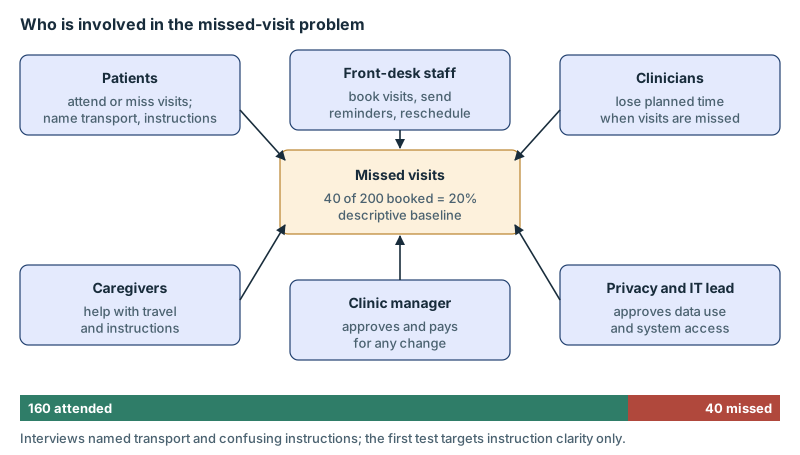
Six roles surround the problem: patients, front-desk staff, clinicians, caregivers, the clinic manager who approves and pays for change, and the privacy and IT lead who approves data use. A bar below shows 160 attended and 40 missed visits out of 200, a 20% rate. This is a descriptive baseline, not proof that reminders would help. Interviews pointed to transport and confusing instructions, and the first test is narrowed to instruction clarity, with transport recorded as an open constraint.
Stakeholders around a 20% missed-visit baseline — Stakeholder map for a synthetic clinic where 40 of 200 booked visits were missed (20%). Synthetic teaching data from the module worked example. Original course illustration.
LESSON 1.1 · 20 MINUTES PLUS PRACTICE

Understand the decision: Define the need before proposing a product

A healthcare venture begins with a specific unmet need, not a preferred app. Define who experiences the problem, in what setting, how often, and with what consequences. Separate the person receiving care from the user, purchasing organization, and payer: their priorities and authority may differ. A waiting-time complaint may arise from scheduling, transport, staffing, or communication. A digital reminder addresses only some of those causes. Write a problem statement that can be contradicted by observations; avoid assuming that demand for help equals willingness or ability to pay.

Worked example

A synthetic clinic logged 200 booked visits and 40 missed visits in a month: 40/200 = 20%. This is a descriptive baseline, not proof that reminders will reduce missed visits. Ten interviews identify transport and confusing instructions. The team narrows its first test to instruction clarity and records transport as an unresolved constraint.

In a hospital shuttle program, patients ride the shuttle, dispatch staff schedule it, and the hospital operations budget pays for it. Who is the buyer?

Choose an answer, then compare your reasoning
Check your reasoning (unscored)

The hospital operations budget holder. The buyer controls the budget and the purchase decision. Patients are the beneficiaries and dispatch staff are the users; their priorities matter, but neither signs the contract.

Apply the idea

Write a one-page problem brief, map three roles, calculate the missed-visit baseline, and name evidence that would make you revise the proposed service. Explain your assumptions, independently check a result, and record what would change your conclusion.

LESSON 1.2 · 20 MINUTES PLUS PRACTICE

Apply a transparent method: Define the need before proposing a product

Map the present journey from first contact to completion. Identify a measurable baseline and a plausible comparison. Record each claim as observed evidence, an interpretation, or an assumption. Interview guides should ask about a recent event rather than solicit praise for the proposed solution. Use synthetic or appropriately authorized, minimized information; an educational discovery exercise does not authorize access to patient records.

Worked example

A synthetic physiotherapy service maps its journey: referral, booking call, confirmation letter, visit. Records show 150 referrals and 105 completed first visits in a quarter: 105/150 = 70% completion, so 45 referrals (30%) did not complete. The team logs three entries separately: observed (45 non-completions), interpretation (the confirmation letter may be unclear), and assumption (a text message would help). Interviews ask about the last missed booking rather than opinions of a proposed app.

Three of ten interviewees say discharge instructions were confusing. How should this go in the evidence register?

Choose an answer, then compare your reasoning
Check your reasoning (unscored)

Observed: 3 of 10 interviewees reported confusing instructions; causes still to test. The register separates observation, interpretation, and assumption. What was heard is an observation with its denominator. Calling it a proven cause skips the testing step.

Apply the idea

Write a one-page problem brief, map three roles, calculate the missed-visit baseline, and name evidence that would make you revise the proposed service. Explain your assumptions, independently check a result, and record what would change your conclusion.

LESSON 1.3 · 20 MINUTES PLUS PRACTICE

Evaluate and revise: Define the need before proposing a product

Judge a problem statement by specificity, significance, and testability. A promising venture must also fit available capacity and avoid shifting burdens to excluded groups. Set a stop or revision condition before seeking supportive interviews. A negative result can save resources and improve the proposal. A statement about improved health needs much stronger evidence than a statement about a shorter administrative task.

Worked example

A draft statement says: "Our app will cut missed visits by half and improve health." Review finds no baseline, no comparison, and a health claim the team cannot measure. The revision reads: "At one synthetic clinic, 30 of 150 monthly bookings (20%) are missed; we will test whether clearer instructions reduce missed bookings, and revise if fewer than 4 of 12 interviewees describe instruction problems." Health outcomes are named as a later question, not a promise.

Which problem statement is most testable?

Choose an answer, then compare your reasoning
Check your reasoning (unscored)

At one clinic, 20% of follow-up visits are missed each month; we will revise if fewer than 3 of 10 interviewees describe instruction problems. A testable statement names a setting, a measured baseline, and a condition that would make the team change course. The other statements cannot be contradicted by any observation.

Apply the idea

Write a one-page problem brief, map three roles, calculate the missed-visit baseline, and name evidence that would make you revise the proposed service. Explain your assumptions, independently check a result, and record what would change your conclusion.

GUIDED PRACTICE · UNGRADED

Guided practice: Define the need before proposing a product

All amounts and observations below are synthetic. Currency is USD unless stated otherwise. Do not submit real personal, patient, employer, or bank records.

Synthetic module dataset
Case componentSynthetic teaching record
ScenarioA synthetic clinic logged 200 booked visits and 40 missed visits in a month: 40/200 = 20%. This is a descriptive baseline, not proof that reminders will reduce missed visits. Ten interviews identify transport and confusing instructions. The team narrows its first test to instruction clarity and records transport as an unresolved constraint.
TaskWrite a one-page problem brief, map three roles, calculate the missed-visit baseline, and name evidence that would make you revise the proposed service.
Evidence statusFictional classroom data; no actual client, patient or account records
  1. Write a one-page problem brief, map three roles, calculate the missed-visit baseline, and name evidence that would make you revise the proposed service.
  2. Show calculations or a reproducible evidence trail with a date, units, and source or assumption labels.
  3. Develop one downside or contradictory-evidence case. Explain its practical implication.
  4. Submit a workbook or evidence table and a 300–500-word decision brief, with an accessible equivalent of any visual.

Submit the calculation or evidence table, the brief, and a revision log. An instructor reviews the rubric; the page does not assign a manual grade.

Compare with the worked guidance

A synthetic clinic logged 200 booked visits and 40 missed visits in a month: 40/200 = 20%. This is a descriptive baseline, not proof that reminders will reduce missed visits. Ten interviews identify transport and confusing instructions. The team narrows its first test to instruction clarity and records transport as an unresolved constraint. A strong answer also identifies omitted conditions, checks the method, and defends a feasible next step.

Attempt your own response before opening this guidance. Compare methods and assumptions, then record a revision.

Discussion 1 Evidence discussion

Write a one-page problem brief, map three roles, calculate the missed-visit baseline, and name evidence that would make you revise the proposed service. Present the strongest objection to your recommendation and respond using the evidence and limitations.

Write 200 to 300 words using a course source or case record, then respond with a reasoned question or counterargument. In solo study, write the strongest counterargument yourself. Do not publish confidential information.

Discussion rubric totaling 10 points
CriterionSample points
Supported analysis4
Source or case evidence3
Response or counterargument2
Clarity respect and attribution1

Watch for these errors

Claim to examine: If people complain about a problem, they will pay for a solution.

A need is not the same as demand. Someone with budget authority must value the solution enough to buy it, and the solution must address the actual cause of the complaint.

Claim to examine: The patient is always the customer.

The person receiving care, the staff member using a tool, the organization buying it, and the payer can all be different people with different priorities. Name each role.

Your turn: Missed-visit baseline for a new service line

A synthetic cardiology clinic wants a baseline before testing any change. Calculate the rates from its booking log.

  • Month 1: 320 booked visits, 48 missed
  • Month 2: 300 booked visits, 36 missed

Compare with the solution

Month 1: 48/320 = 15%. Month 2: 36/300 = 12%. The rate fell 3 percentage points. Two months of descriptive data cannot show why; seasonality or staffing changes could explain the drop, so the team records it as a baseline, not a result.

Explain it in your own words

Why is a missed-visit baseline not evidence that a reminder service will work?

Compare with a model explanation

A baseline only describes how often visits are missed now. It says nothing about causes. Visits may be missed because of transport, cost, confusing instructions, or work schedules, and a reminder addresses only some of these. To show a reminder helps, the team would need to test it against a comparison and measure the same outcome the same way. Until then, the baseline sets the starting point and the problem statement stays open to revision.

Close the module

Without notes, write a testable problem statement for a service you know and name its user, buyer, and payer.

For each lesson, rate confidence from 1 (need help) to 5 (can explain independently). Check that judgment against a fresh question. Identify your muddiest point and schedule a review in two days and again next week.

All activities in this section are unscored and do not change checkpoint grades.

Module 1 checkpoint

Five questions · 5 practice points · untimed · three attempts, best retained. Complete every question before submitting. This is formative practice; feedback is available after submission.

1. Which is a testable problem statement?
2. What is the missed-visit rate for 40 of 200 bookings?
3. Who may differ from the service user?
4. Does the baseline show a reminder caused an improvement?
5. What belongs in the evidence register?

MODULE 2 · PUBLIC PREVIEW

Opportunity evidence and market boundaries

Compare a market claim with its evidence and construct a bottom-up estimate with explicit boundaries.

Learning outcomes 1, 2, 8 · Selected reading E 5 and 6; M 2 and 6

Reasoning sequence for Opportunity evidence and market boundariesRecordsReconcileInterpretDecide
Original concept map for Opportunity evidence and market boundaries. Teaching sequence: Records → Reconcile → Interpret → Decide. The labels summarize reasoning rather than measured data; quantitative results appear in the worked examples and model tables.

Module roadmap

Build a bottom-up market estimate with labeled assumptions and test how capacity and competitors limit it.

Suggested study time: 120 minutes, plus assessment and independent practice. Follow the lessons in order, retrieve the ideas, then apply and review.

Before you start: make a prediction

A team multiplies 2 million people with a condition by a $50 monthly price and calls the result its market. What is the main weakness?

Choose an answer, then compare your reasoning
Check your reasoning (unscored)

It ignores who can be reached, who buys, and who will adopt. A top-down count treats every affected person as a paying customer. A useful estimate counts buying units that are eligible, reachable, and likely to adopt under a defined offer.

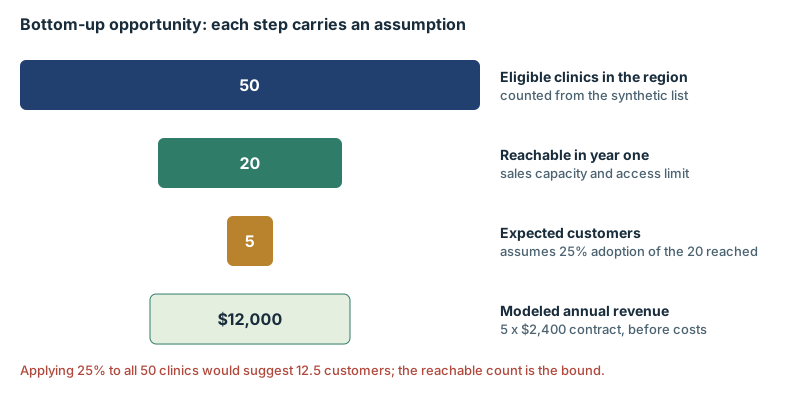
Four stacked steps narrow from 50 eligible clinics to 20 that can be reached in year one, then to 5 expected customers under an assumed 25% adoption rate among those reached. At $2,400 per annual contract, modeled revenue is $12,000 before implementation costs and collection risk. A note warns that applying the adoption rate to all 50 clinics would give 12.5, which ignores the reach limit.
Opportunity funnel from 50 clinics to 5 customers — Bottom-up opportunity funnel: 50 eligible clinics, 20 reachable, 5 expected customers, $12,000 modeled revenue. Synthetic teaching data from the module worked example. Original course illustration.
LESSON 2.1 · 20 MINUTES PLUS PRACTICE

Understand the decision: Bound the opportunity and the market

Market size is a set of assumptions about people or organizations that could be served under a defined offer, geography, and period. Distinguish the broad need from the segment that is eligible, reachable, and realistically serviceable. Multiplying a national disease count by a hoped-for price usually ignores reimbursement, purchasing authority, competitors, capacity, and access. Begin with a bottom-up count of plausible buying units and their workflow rather than treating every affected person as a paying customer.

Worked example

The synthetic region has 50 eligible clinics. Of these, 20 can be reached in the first year, and the team assumes 25% adoption among those 20. This suggests 5 customers, not 12.5 customers from all 50. At $2,400 per annual contract, modeled annual revenue is $12,000 before implementation costs and collection risk.

A scheduling service is sold to independent clinics in one state. Which group is the serviceable segment?

Choose an answer, then compare your reasoning
Check your reasoning (unscored)

Independent clinics in that state with a compatible scheduling system that can be contacted this year. The serviceable segment is bounded by the offer, geography, period, and technical fit. Counting all adults confuses people with a need with organizations that could buy.

Apply the idea

Build an auditable market funnel; halve the adoption assumption and explain how capacity and competitors affect the result. Explain your assumptions, independently check a result, and record what would change your conclusion.

LESSON 2.2 · 20 MINUTES PLUS PRACTICE

Apply a transparent method: Bound the opportunity and the market

State the unit of sale: an appointment, subscription, facility contract, or implementation package. Build a funnel from eligible organizations to reachable prospects to feasible adopters. Label quantities and periods in the model. Compare at least two independent evidence sources, noting publication date and population. Keep adoption assumptions separate from observed counts; show a range rather than disguising uncertain assumptions as precise forecasts.

Worked example

A synthetic home-care software offer is sold per agency. Step 1: eligible agencies in the region, 60 (from a dated registry count). Step 2: reachable in year one through two partner associations, 24. Step 3: assumed adoption of 15% to 30% of reachable agencies, giving 3.6 to 7.2, or about 4 to 7 whole agencies. Step 4: at $3,000 per year, modeled revenue is $12,000 to $21,000. Observed counts and assumptions sit in separate, labeled columns.

80 pharmacies are eligible, 30 are reachable this year, the team assumes 20% adoption among reachable pharmacies, and contracts are $1,800 a year. What is modeled annual revenue?

Choose an answer, then compare your reasoning
Check your reasoning (unscored)

$10,800. 30 x 20% = 6 customers, and 6 x $1,800 = $10,800. Applying adoption to all 80 eligible pharmacies gives $28,800, which ignores reach.

Apply the idea

Build an auditable market funnel; halve the adoption assumption and explain how capacity and competitors affect the result. Explain your assumptions, independently check a result, and record what would change your conclusion.

LESSON 2.3 · 20 MINUTES PLUS PRACTICE

Evaluate and revise: Bound the opportunity and the market

A market estimate is useful when a reviewer can reproduce it and see what would change the result. Capacity can be more binding than demand. A competitive alternative may be a spreadsheet or an existing staff process rather than another startup. Revisit market boundaries when the proposed workflow, buyer, or pricing changes; the market is not a permanent number attached to the idea.

Worked example

A plan claims 50 hospital customers in year one from a 500-hospital market (10%). Review finds the team can complete 3 implementations a month, or 36 a year, and the main competitor is the hospitals' existing spreadsheet process. The revised estimate caps year one at 36 and shows a downside of 18 if procurement delays push first contracts back six months. Capacity, not demand, now sets the upper bound, and the spreadsheet is listed as the alternative to beat.

A market model assumes 40 implementations next year, but the team can complete only 2 a month. What should change?

Choose an answer, then compare your reasoning
Check your reasoning (unscored)

Cap year-one customers at 24 and show capacity as the binding limit. Two a month for 12 months is 24. Capacity can limit results more than demand, and a reviewer should see that limit in the model. Keeping 40 assumes work the team cannot do.

Apply the idea

Build an auditable market funnel; halve the adoption assumption and explain how capacity and competitors affect the result. Explain your assumptions, independently check a result, and record what would change your conclusion.

APPLIED LAB · 15 SAMPLE POINTS · HUMAN REVIEW

Applied studio: Bound the opportunity and the market

All amounts and observations below are synthetic. Currency is USD unless stated otherwise. Do not submit real personal, patient, employer, or bank records.

Synthetic module dataset
Case componentSynthetic teaching record
ScenarioThe synthetic region has 50 eligible clinics. Of these, 20 can be reached in the first year, and the team assumes 25% adoption among those 20. This suggests 5 customers, not 12.5 customers from all 50. At $2,400 per annual contract, modeled annual revenue is $12,000 before implementation costs and collection risk.
TaskBuild an auditable market funnel; halve the adoption assumption and explain how capacity and competitors affect the result.
Evidence statusFictional classroom data; no actual client, patient or account records
  1. Build an auditable market funnel; halve the adoption assumption and explain how capacity and competitors affect the result.
  2. Show calculations or a reproducible evidence trail with a date, units, and source or assumption labels.
  3. Develop one downside or contradictory-evidence case. Explain its practical implication.
  4. Submit a workbook or evidence table and a 300–500-word decision brief, with an accessible equivalent of any visual.

Submit the calculation or evidence table, the brief, and a revision log. An instructor reviews the rubric; the page does not assign a manual grade.

Lab rubric totaling 15 points
CriterionSample points
Accuracy and evidence6
Method and traceability4
Interpretation and limitations3
Clarity and attribution2
Compare with the worked guidance

The synthetic region has 50 eligible clinics. Of these, 20 can be reached in the first year, and the team assumes 25% adoption among those 20. This suggests 5 customers, not 12.5 customers from all 50. At $2,400 per annual contract, modeled annual revenue is $12,000 before implementation costs and collection risk. A strong answer also identifies omitted conditions, checks the method, and defends a feasible next step.

Attempt your own response before opening this guidance. Compare methods and assumptions, then record a revision.

Watch for these errors

Claim to examine: A large disease prevalence number shows a large market.

Prevalence counts people with a need. A market counts buyers who are eligible, reachable, able to pay, and likely to adopt a defined offer in a defined period.

Claim to examine: Our only competitors are other startups.

The usual competitor is the current way of working: a spreadsheet, a phone call, or a staff routine. Buyers compare your offer with doing nothing new.

Your turn: Bottom-up funnel for a referral tool

Build the funnel for a synthetic referral-tracking tool sold to clinics, then test a lower adoption assumption.

  • Eligible clinics: 120
  • Reachable this year: 45
  • Assumed adoption among reachable clinics: 20%
  • Annual contract: $2,000

Compare with the solution

45 x 20% = 9 clinics; 9 x $2,000 = $18,000. At 10% adoption, 4.5 clinics (a modeling average, not whole clinics) x $2,000 = $9,000. Halving an untested assumption halves the result, so the model shows a range and labels adoption as an assumption.

Explain it in your own words

Why can capacity be more binding than demand in a healthcare market estimate?

Compare with a model explanation

Healthcare offers often need implementation, training, and integration for each customer. A small team can complete only a few of these each month, so even if many buyers are interested, the number served in a year is limited by delivery capacity. Procurement time adds further delay. A market estimate that ignores capacity promises revenue the team cannot deliver. Showing capacity as a cap lets reviewers see what must change, such as more staff or a simpler setup, before the estimate can grow.

Spaced review

Retrieve earlier ideas before checking the feedback.

Who may differ from the service user?

Choose an answer, then compare your reasoning
Check your reasoning (unscored)

The buyer and payer. The buyer and payer. A synthetic clinic logged 200 booked visits and 40 missed visits in a month: 40/200 = 20%. This is a descriptive baseline, not proof that reminders will reduce missed visits. Ten interviews identify transport and confusing instructions. The team narrows its first test to instruction clarity and records transport as an unresolved constraint.

Which is a testable problem statement?

Choose an answer, then compare your reasoning
Check your reasoning (unscored)

40 of 200 booked visits were missed in the observed month. 40 of 200 booked visits were missed in the observed month. A synthetic clinic logged 200 booked visits and 40 missed visits in a month: 40/200 = 20%. This is a descriptive baseline, not proof that reminders will reduce missed visits. Ten interviews identify transport and confusing instructions. The team narrows its first test to instruction clarity and records transport as an unresolved constraint.

Close the module

Close your notes and rebuild the four-step bottom-up funnel, labeling which numbers are observed and which are assumed.

For each lesson, rate confidence from 1 (need help) to 5 (can explain independently). Check that judgment against a fresh question. Identify your muddiest point and schedule a review in two days and again next week.

All activities in this section are unscored and do not change checkpoint grades.

Module 2 checkpoint

Five questions · 5 practice points · untimed · three attempts, best retained. Complete every question before submitting. This is formative practice; feedback is available after submission.

1. Which is a bottom-up market model?
2. Twenty reachable clinics times 25% adoption gives how many customers?
3. Five annual contracts at $2,400 generate modeled revenue of?
4. Which can be a competitor?
5. How should an adoption percentage be labeled without sales evidence?

WORKSPACE.MCPLENI.COM

Your tools beside your learning

Use an embedded McNova editor here, or open the current Workspace version in a new tab. Deneb embeds a dated, reviewed copy of the Workspace tools. Workspace links always open the currently published version. Use synthetic data and save or export before switching; nothing is automatically submitted or graded.

McNova Sheets

Build budgets, ratios, amortization, and project cash flow models.

Open Workspace version

McNovaDocs

Draft management memos, evidence logs, and reflections.

Open Workspace version

McNova Presentations

Prepare an accessible decision briefing or venture pitch.

Open Workspace version

McNovaPDF Workbench

Read and annotate authorized resources and exported reports.

Open Workspace version

McNova AI Writing Pro

Develop and review an evidence brief. Use synthetic information and verify AI proposals.

Open Workspace version

McNova Speech Pro

Read aloud or prepare a reviewed transcript. Speech recognition remains a development preview.

Open Workspace version

Choose a built-in editor above to begin. In the desktop review copy, use a Workspace link or open the live course to use Deneb’s embedded editors.

Workspace apps open separately because their current security policy blocks embedding on other sites. Deneb’s existing built-in McNova editors remain available inside the live course. There is no automatic file transfer or grade synchronization.

PRIVATE BROWSER PRACTICE

Your practice record

No final course grade is calculated from incomplete or unreviewed work. The 500-point grading table is a sample framework. Practice records are editable browser data, not a verified transcript.

Quick reference

Define the need before proposing a product
A healthcare venture begins with a specific unmet need, not a preferred app.
Bound the opportunity and the market
Market size is a set of assumptions about people or organizations that could be served under a defined offer, geography, and period.
Conduct discovery without excluding people
Customer discovery explores how work and care happen before testing a sales pitch.
Connect value creation to a viable model
A value proposition states the job a particular user or buyer needs done, the difficulty in the present approach, and the benefit the proposed offer could provide.
Fit the technology to the workflow
Technology architecture describes how data, interfaces, people, and services work together.