DBUS635 · TEACHING DRAFT FOR REVIEW

Managerial Accounting and Finance

Use managerial accounting and corporate finance to evaluate operating choices, budgets, investment projects, and financing strategies. Build and audit spreadsheet models, interpret financial statements, and explain how assumptions, uncertainty, and ethical responsibilities affect recommendations. A fictional service organization provides a continuous decision case, with manufacturing comparisons where they clarify cost systems.

16 modules48 lessonsNo academic credit500 sample points

No academic credit awarded. Sample grading guidance totals 500 points. Quizzes are browser practice; assignments, case reviews, and the capstone require human review.

How this course is designed to help you learn

Predict before reading. Study a worked example, explain the method, try a problem, and retrieve the ideas without notes. Revisit earlier modules over several sessions. Use confidence ratings to choose what to review; check performance rather than judging familiarity alone.

  • Module roadmap: Preview the sequence, time, and objectives. Advance organizers and clear signaling reduce extraneous load and help you connect new ideas to a structure (Mayer, 2021).
  • Make a prediction: Answer one question before the lessons. Pretesting improves later learning of the tested content, even after an error, if feedback follows (Richland et al., 2009; Pan & Carpenter, 2023).
  • Retrieval check after each lesson: Answer from memory, then read the explanation. Practice testing is among the most effective study methods; explanatory feedback corrects errors (Roediger & Karpicke, 2006; Dunlosky et al., 2013; Hattie & Timperley, 2007).
  • New diagrams with text descriptions: Study the picture and its words together. Words with related graphics support deeper understanding than words alone; text descriptions keep the content accessible (Mayer, 2021; CAST, 2024).
  • Watch for these errors: Compare a common error with better reasoning. Refutation text that names and corrects a misconception changes understanding more than explanation alone (Tippett, 2010).
  • Your turn / Draw to learn: Complete a faded problem or sketch from memory. Fading worked-example steps and generative drawing build independent skill (Renkl & Atkinson, 2003; Fiorella & Mayer, 2016).
  • Explain it in your own words: Write a short causal explanation. Self-explanation and elaborative questioning improve transfer (Chi et al., 1994; Dunlosky et al., 2013).
  • Spaced review: Answer questions from earlier modules. Distributed and interleaved practice improves retention and method selection (Cepeda et al., 2006; Rohrer & Taylor, 2007).
  • Close the module: Free recall, confidence rating, muddiest point. Self-monitoring and calibration support self-regulated learning and better restudy choices (Zimmerman, 2002; Bjork et al., 2013).
Research informing the learning design
  • Bjork, R. A., Dunlosky, J., & Kornell, N. (2013). Self-regulated learning: Beliefs, techniques, and illusions. Annual Review of Psychology, 64, 417-444.
  • CAST. (2024). Universal Design for Learning Guidelines version 3.0. https://udlguidelines.cast.org
  • Cepeda, N. J., Pashler, H., Vul, E., Wixted, J. T., & Rohrer, D. (2006). Distributed practice in verbal recall tasks: A review and quantitative synthesis. Psychological Bulletin, 132(3), 354-380.
  • Chi, M. T. H., de Leeuw, N., Chiu, M.-H., & LaVancher, C. (1994). Eliciting self-explanations improves understanding. Cognitive Science, 18(3), 439-477.
  • Dunlosky, J., Rawson, K. A., Marsh, E. J., Nathan, M. J., & Willingham, D. T. (2013). Improving students’ learning with effective learning techniques. Psychological Science in the Public Interest, 14(1), 4-58.
  • Fiorella, L., & Mayer, R. E. (2016). Eight ways to promote generative learning. Educational Psychology Review, 28(4), 717-741.
  • Freeman, S., Eddy, S. L., McDonough, M., et al. (2014). Active learning increases student performance in science, engineering, and mathematics. PNAS, 111(23), 8410-8415.
  • Hattie, J., & Timperley, H. (2007). The power of feedback. Review of Educational Research, 77(1), 81-112.
  • Mayer, R. E. (2021). Multimedia Learning (3rd ed.). Cambridge University Press.
  • Pan, S. C., & Carpenter, S. K. (2023). Prequestioning and pretesting effects: A review of empirical research, theoretical perspectives, and implications for educational practice. Educational Psychology Review, 35, 97.
  • Renkl, A., & Atkinson, R. K. (2003). Structuring the transition from example study to problem solving in cognitive skill acquisition. Educational Psychologist, 38(1), 15-22.
  • Richland, L. E., Kornell, N., & Kao, L. S. (2009). The pretesting effect: Do unsuccessful retrieval attempts enhance learning? Journal of Experimental Psychology: Applied, 15(3), 243-257.
  • Roediger, H. L., & Karpicke, J. D. (2006). Test-enhanced learning: Taking memory tests improves long-term retention. Psychological Science, 17(3), 249-255.
  • Rohrer, D., & Taylor, K. (2007). The shuffling of mathematics problems improves learning. Instructional Science, 35(6), 481-498.
  • Sweller, J., van Merriënboer, J. J. G., & Paas, F. (2019). Cognitive architecture and instructional design: 20 years later. Educational Psychology Review, 31, 261-292.
  • Tippett, C. D. (2010). Refutation text in science education: A review of two decades of research. International Journal of Science and Mathematics Education, 8(6), 951-970.
  • Zimmerman, B. J. (2002). Becoming a self-regulated learner: An overview. Theory Into Practice, 41(2), 64-70.
COURSE SYLLABUS

Learn to support a decision with evidence

Use managerial accounting and corporate finance to evaluate operating choices, budgets, investment projects, and financing strategies. Build and audit spreadsheet models, interpret financial statements, and explain how assumptions, uncertainty, and ethical responsibilities affect recommendations. A fictional service organization provides a continuous decision case, with manufacturing comparisons where they clarify cost systems.

What you will be able to do

  1. Interpret linked financial statements and evaluate liquidity, profitability, leverage, and cash generation.
  2. Classify costs and apply cost behavior, contribution margin, and relevant cost analysis to operating decisions.
  3. Compare job, process, and activity based costing and explain allocation effects on decisions.
  4. Construct operating and cash budgets and analyze flexible budget and standard cost variances.
  5. Calculate present values, loan payments, net present value, and internal rate of return with consistent timing.
  6. Evaluate project cash flows, financing choices, cost of capital, and working capital under explicit assumptions.
  7. Test model sensitivity and assess ethical, sustainability, and measurement risks.
  8. Defend a financially supported management recommendation using an auditable workbook and concise evidence.

Preparation and audience

Recommended preparation is introductory financial accounting, basic algebra, and spreadsheet formulas. A diagnostic and optional statement analysis and spreadsheet refreshers support learners who need a bridge. The adopting institution determines formal prerequisites. This is proposed as a graduate course with a foundation review.

Higher education learners in advanced business, administration, and management programs

Sample grading criteria

Potential distribution of 500 sample points
AssessmentDistributionPotential pointsWeight
Module checkpoints16 × 5 points8016%
Applied labs or studios8 × 15 points12024%
Evidence discussions6 × 10 points6012%
Module 8 case review3 × 30 points9018%
Final capstoneIntegrated final submission15030%
Total500100%

Course percentage = accrued reviewed points ÷ 500 × 100. Apply cutoffs to the unrounded percentage. Fractional reviewed points are allowed; ranges use an exclusive upper bound to avoid gaps. A checkpoint practice subtotal is not a final course grade.

Sample letter grade scale confirmed by the course owner
GradePercentageAccrued points
A95–100%475–500
A−90–<95%450–<475
B+85–<90%425–<450
B80–<85%400–<425
B−75–<80%375–<400
C70–<75%350–<375
FailureBelow 70%0–<350

Final project

A final integrated project is included in the sample grading plan. Sign in to review the detailed assignment and assessment guidance.

Capstone rubric totaling 150 sample points
CriterionPotential pointsExpected evidence
Accounting and financial accuracy45Statements and budgets reconcile; costs and cash flows are relevant; units and timing are consistent.
Model design and assurance30Inputs are traceable, formulas auditable, checks visible, and errors corrected.
Risk and alternatives30Sensitivity results support an alternative and explain material limits.
Recommendation and ethics30Choice follows evidence, addresses stakeholders, and states decision conditions.
Communication and attribution15Memo and briefing are clear; sources, visuals, assumptions, and AI use are disclosed.

Course policies

Credit and sample grades

No academic credit, official grade, transcript, continuing education unit, or professional certification is awarded. The 500-point framework and letter scale are sample grading guidance. Auto-scored checkpoint practice is separate from work requiring human review. Unreviewed work never receives invented instructor points.

Pacing and workload

Sixteen modules with a suggested 16-week sequence, or eight weeks pairing successive modules. Plan about 135 total learning hours including reading, practice, modeling, and the capstone. This is a study estimate, not assigned credit or verified contact hours. Suggested dates do not lock self-paced access.

Public and signed-in access

Modules 1 and 2 are public. Modules 3 through 16 require an active verified Deneb sign-in. The desktop review package contains the complete authorized draft. Public course responses and downloads contain only public teaching content. Signing in does not grant faculty or administrator privileges.

Materials and tools

Use linked free publisher readings, a browser, and a way to save work. Deneb provides its existing embedded McNova Docs, Sheets, Presentations, and PDF editors. Links open the current workspace.mcpleni.com versions, Equations, and Drawing separately. Tool versions can differ. Export before switching; storage and sign-in are separate, and no automatic transfer or grade synchronization is claimed.

Practice records

Checkpoint answers, notes, and completion markers are browser practice records. They are not server-submitted coursework or a verified transcript. Signed-in practice uses an account-specific opaque storage scope. Export records before clearing storage or changing devices. Public practice is not silently merged into an account.

Feedback and integrity

Five untimed one-point questions per module, up to three recorded browser attempts, best score retained, and explanations after submission. This is formative study, not a secure examination. In a facilitated offering an instructor must publish contacts, deadlines, feedback expectations, late work and appeals before enrollment.

AI and privacy

Try calculations independently. AI may explain terminology, suggest a study plan, or help edit a draft when disclosed. Verify arithmetic and claims against the course and cited sources. Never invent evidence or upload patient, student, employer, bank, or credential information. All datasets are synthetic.

Accessibility

Lessons are text-first. Original diagrams include text descriptions and tables; calculators provide labeled inputs and readable results. Quizzes are untimed. Written alternatives are available for spoken briefings, and a spreadsheet can be replaced by equivalent calculation tables. Report barriers to the adopting instructor or service@nelyant.com.

Review and scope

Academic and subject-matter review remains pending. The course is management education, not personalized investment, tax, accounting compliance, or legal advice. Rates and tax inputs are labeled hypothetical; current regulations and reporting frameworks need dated specialist review in an adopted course.

Sources and further reading

Lesson text, examples, datasets, questions, and diagrams are original to this draft. Publisher readings are linked rather than reproduced. Supplied editions have varying reuse terms; exact-edition and figure exclusions require review before copying any textbook asset.

MODULE 1 · PUBLIC PREVIEW

Management decisions and financial information

Distinguish internal decision information from external reporting and identify an ethical reporting conflict.

Learning outcomes 1, 8 · Selected reading MA 1; F2 1 and 2; FA 1 and 2 review

Reasoning sequence for Management decisions and financial informationRecordsReconcileInterpretDecide
Original concept map for Management decisions and financial information. Teaching sequence: Records → Reconcile → Interpret → Decide. The labels summarize reasoning rather than measured data; quantitative results appear in the worked examples and model tables.

Module roadmap

Learn to separate the decision question from the historical record, spot reporting incentives, and set up a workbook another person can check.

Suggested study time: 75 minutes, plus assessment and independent practice. Follow the lessons in order, retrieve the ideas, then apply and review.

Before you start: make a prediction

Northstar spent $5,000 on a feasibility study last month. Today it must decide whether to launch the service. Which amounts belong in today's comparison?

Choose an answer, then compare your reasoning
Check your reasoning (unscored)

Only future costs and benefits that differ between launching and not launching. A forward choice compares future amounts that change with the choice. The $5,000 is spent whichever option is chosen, so it cannot separate the alternatives, although the study's findings may still be useful evidence.

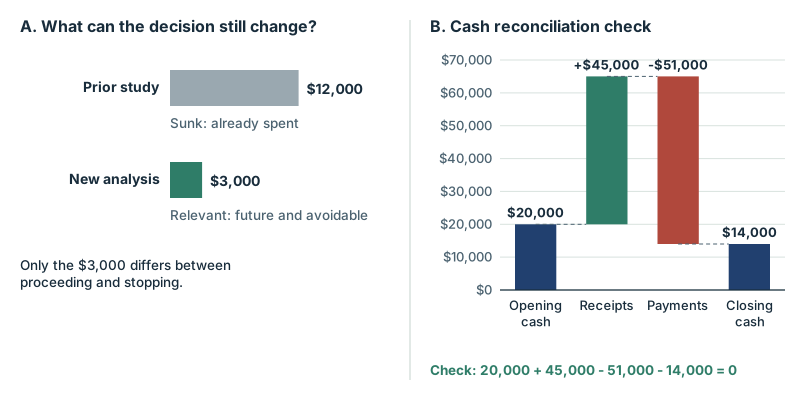
Panel A: two horizontal bars. The prior study bar shows $12,000 and is labeled sunk, already spent. The new analysis bar shows $3,000 and is labeled relevant, future and avoidable. Only the $3,000 differs between proceeding and stopping. Panel B: a waterfall chart. Opening cash is $20,000. Receipts add $45,000. Payments subtract $51,000. Closing cash is $14,000. The reconciliation check 20,000 plus 45,000 minus 51,000 minus 14,000 equals zero.
Separating relevant amounts and checking cash — Panel A contrasts the $12,000 prior market study, which is sunk, with the $3,000 new analysis, the only amount that changes with the decision. Panel B rebuilds closing cash from opening cash, receipts, and payments. All amounts are synthetic teaching data. Original course illustration.
LESSON 1.1 · 15 MINUTES PLUS PRACTICE

Accounting information and the management question

Financial accounting summarizes transactions for external users through statements prepared under an applicable reporting framework. Managerial accounting supplies information for a particular internal decision. Its useful unit might be a service visit, a department, a customer segment, or a scarce staff hour. A measure can be suitable for one question and unsuitable for another.

Begin by naming the decision, decision maker, alternatives, time horizon, and constraints. Ask whether the information describes what happened or estimates what would change. An annual expense includes past commitments; a forward staffing decision requires future avoidable costs and likely service effects. Neither a historical total nor a dashboard label answers that question alone.

Northstar Community Services is the fictional organization used throughout this course. Its records and forecasts are invented for teaching. The relevant stakeholder set includes customers, employees, lenders, owners, and the community. A recommendation should state who gains, who bears risk, and what evidence is missing. Financial analysis supports judgment; it does not remove the need to examine quality, access, and practical feasibility.

Worked example

Northstar paid $12,000 for last year's market study. A proposed extension would require a new $3,000 analysis. The earlier $12,000 is historical; the incremental research cost of proceeding now is $3,000. It still matters that the old study may contain useful evidence, but spending already incurred is not made avoidable by choosing a different future.

Northstar paid $9,000 for staff software training last year. Expanding the program now requires a new $4,000 license. What is the incremental cost of expanding now?

Choose an answer, then compare your reasoning
Check your reasoning (unscored)

$4,000. Only the $4,000 license changes with the decision. The $9,000 was already paid and is sunk. Adding it gives $13,000, a common error; subtracting the two amounts has no decision meaning.

Apply the idea

Name a decision at a fictional service organization. Identify two alternatives, a time horizon, one constraint, and one historical amount that would not change.

LESSON 1.2 · 15 MINUTES PLUS PRACTICE

Governance incentives and ethical reporting

Governance establishes decision rights, accountability, and oversight. Managers often know more about operations than owners or lenders. That information difference creates an agency problem when an incentive rewards a manager for a result that harms the organization or another stakeholder. A short-term margin bonus can encourage postponed maintenance or rejected low-margin customers even when long-term value falls.

Ethical analysis starts with the factual record and the proposed action. Identify the accounting treatment, who benefits, who is exposed, and whether the representation would mislead a reasonable reader. Distinguish an estimation disagreement from knowingly concealing information. Document the uncertainty rather than manufacturing a precise answer.

Controls include clear approval authority, independent review, reconciliations, and a route for raising concerns. A control reduces risk but is not proof that all transactions are correct. Budget pressure does not justify changing classifications to achieve a target. When a reporting question depends on a jurisdiction or formal standard, obtain qualified review and identify the framework and date used.

Worked example

A manager proposes postponing $8,000 of preventive maintenance to raise current operating income. The budget variance improves by $8,000 if no other effects occur, but the proposal may raise failure and service-disruption risk. Report both the immediate effect and the unmodeled risk; do not describe the change as a permanent efficiency gain.

A manager whose bonus depends on quarterly margin proposes recording a $6,000 routine repair as an equipment asset so the target is met. What is the best first response?

Choose an answer, then compare your reasoning
Check your reasoning (unscored)

Document the proposal, name the applicable reporting framework, and obtain independent review. The incentive creates a conflict, and classification depends on the reporting framework rather than the bonus target. Documenting the facts and routing the question to independent review addresses both the accounting question and the agency problem.

Apply the idea

Write a two-sentence disclosure of the maintenance proposal, including an unanswered question and who should review it.

LESSON 1.3 · 15 MINUTES PLUS PRACTICE

Building an auditable decision workbook

An auditable workbook separates assumptions, calculations, and outputs. Put each material input in a labeled cell with units, time period, source, and status such as observed, supplied, or assumed. Reference the input cell instead of repeating an unexplained number in many formulas. Keep a version note so another reader can reproduce the result.

Use reconciliation checks and simple independent calculations. A balance sheet should satisfy assets minus liabilities minus equity equals zero. Cash should reconcile from opening balance through receipts and payments to closing balance. A zero check can coexist with an incorrect assumption, so also ask whether the result is plausible and whether the intended formula uses the right cells.

Label currency, nominal versus real amounts, and monthly versus annual rates. Keep calculation precision internally and round displayed currency deliberately. An assumption is not validated because a spreadsheet accepts it. AI can help explain a formula, but the author must inspect the references, recompute a small example, and disclose material assistance. Never enter confidential organizational records into a study tool.

Worked example

If opening cash is $20,000, receipts $45,000, and payments $51,000, closing cash is $14,000. The check 20,000 + 45,000 - 51,000 - 14,000 equals zero. If a formula shows $140,000 instead, investigate the scale or cell reference before interpreting liquidity.

Opening cash is $18,000, receipts are $52,000, and payments are $47,500. A workbook reports closing cash of $225,000. What should you conclude?

Choose an answer, then compare your reasoning
Check your reasoning (unscored)

Closing cash should be $22,500, so check scale and cell references. 18,000 + 52,000 - 47,500 = 22,500. The reported $225,000 is ten times larger, a pattern that points to a scale or reference error. Fix the model before interpreting liquidity.

Apply the idea

Create an inputs/calculations/outputs layout in Sheets or a text table and include a cash reconciliation check.

GUIDED PRACTICE · UNGRADED

Decision brief and evidence register

All amounts and observations below are synthetic. Currency is USD unless stated otherwise. Do not submit real personal, patient, employer, or bank records.

Synthetic module dataset
ItemAmount USDStatus
Prior study12000Sunk expenditure
New analysis3000Future incremental
Opening cash20000Synthetic record
  1. Name the decision owner, two alternatives, and one constraint.
  2. Classify each amount and identify a missing piece of evidence.
  3. Create separate input, calculation, and output areas in Sheets.

An auditable workbook or equivalent calculation table, a 250-word interpretation, and an assumptions and source log.

Compare with the worked guidance

The $12,000 is sunk; the $3,000 is a future difference if required by the selected option. Cash is a balance, not revenue. A decision brief must still identify demand, capacity, and the feasible counterfactual.

Attempt your own response before opening this guidance. Compare methods and assumptions, then record a revision.

Watch for these errors

Claim to examine: Money already spent on a project must be counted again when deciding whether to continue it.

Past spending cannot be changed by today's choice. Compare future costs and benefits that differ, and use the earlier work only as evidence.

Claim to examine: If a workbook's check cell shows zero, the analysis is correct.

A zero check confirms arithmetic consistency. It does not confirm that the assumptions, sources, or chosen formulas fit the decision.

Your turn: Decision brief numbers with a reconciliation check

Northstar is deciding whether to add a weekend clinic. Complete the numbers a reviewer would need.

  • Earlier site survey already paid: $8,000
  • New demand survey needed only if the clinic goes ahead: $2,500
  • Opening cash: $25,000; receipts: $61,000; payments: $58,500
  • Closing cash reported in the workbook: $27,500

Compare with the solution

Only the $2,500 survey changes with the decision; the $8,000 is sunk. Closing cash is 25,000 + 61,000 - 58,500 = $27,500. The check 25,000 + 61,000 - 58,500 - 27,500 = 0 shows the workbook agrees with its inputs, but it does not test whether the receipt forecast is realistic.

Explain it in your own words

Explain why the same expense total can be useful for an external report and unhelpful for a staffing decision.

Compare with a model explanation

An external report summarizes what happened during a period under a reporting framework, so a total expense figure is appropriate there. A staffing decision asks what would change in the future if one option is chosen. The historical total mixes past commitments, costs that will continue either way, and costs that could be avoided. To support the decision, separate the avoidable future costs and the likely service effects, and state the time horizon and constraints.

Close the module

Without notes, list the five elements you should name before analyzing a management decision and give one example of a sunk cost.

For each lesson, rate confidence from 1 (need help) to 5 (can explain independently). Check that judgment against a fresh question. Identify your muddiest point and schedule a review in two days and again next week.

All activities in this section are unscored and do not change checkpoint grades.

Module 1 checkpoint

Five questions · 5 practice points · untimed · three attempts, best retained. Complete every question before submitting. This is formative practice; feedback is available after submission.

1. Which information best answers whether to add one service session?
2. A completed study cost $12,000 and cannot be refunded. What is it for the current decision?
3. Opening cash is $20,000, receipts $45,000, and payments $51,000. Closing cash is:
4. Which workbook design best supports review?
5. Deferring maintenance improves current income. What else should a recommendation disclose?

MODULE 2 · PUBLIC PREVIEW

Statements ratios and cash flow

Reconcile profit to cash and interpret liquidity, profitability, and leverage ratios with consistent denominators.

Learning outcomes 1, 8 · Selected reading F2 4 to 6; FA statement and cash flow topics

Reasoning sequence for Statements ratios and cash flowRecordsReconcileInterpretDecide
Original concept map for Statements ratios and cash flow. Teaching sequence: Records → Reconcile → Interpret → Decide. The labels summarize reasoning rather than measured data; quantitative results appear in the worked examples and model tables.

Module roadmap

Trace how income, balance sheet, and cash flow connect, reconcile income to cash, and read ratios with their limits.

Suggested study time: 90 minutes, plus assessment and independent practice. Follow the lessons in order, retrieve the ideas, then apply and review.

Before you start: make a prediction

A business reports a profit of $40,000 for the year. Which statement must be true?

Choose an answer, then compare your reasoning
Check your reasoning (unscored)

Equity changed by the profit before any distributions, but cash may have fallen. Profit is measured on an accrual basis. Uncollected sales, equipment purchases, and loan repayments can all reduce cash even when profit is positive. Profit adds to equity before distributions to owners.

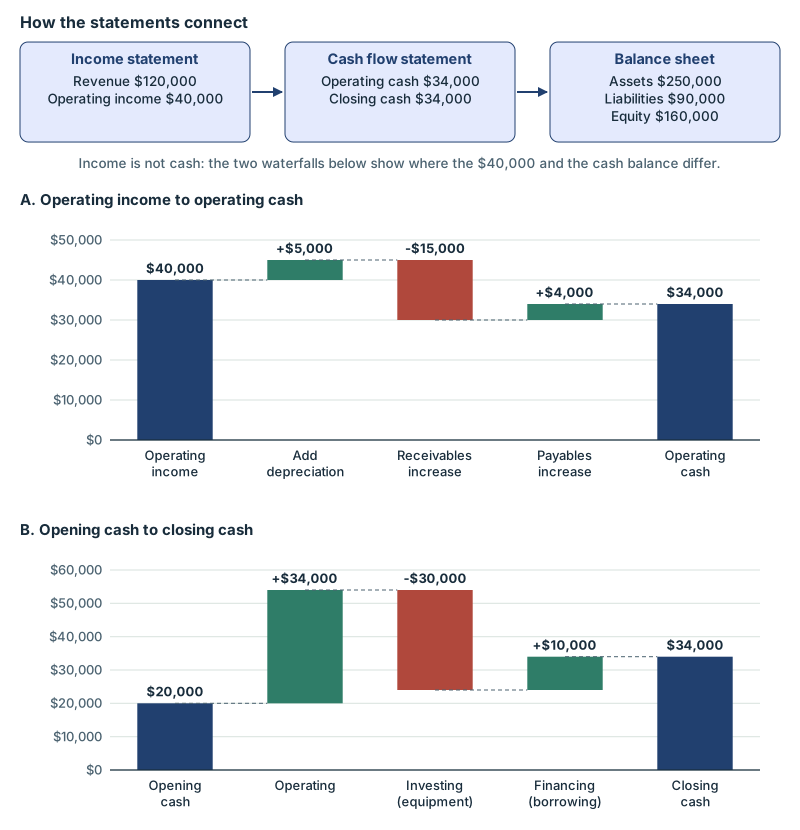
Top row: three linked boxes. Income statement: revenue $120,000, operating income $40,000. Cash flow statement: operating cash $34,000, closing cash $34,000. Balance sheet: assets $250,000, liabilities $90,000, equity $160,000. Panel A waterfall: operating income $40,000, add depreciation $5,000, subtract receivables increase $15,000, add payables increase $4,000, giving operating cash $34,000. Panel B waterfall: opening cash $20,000, add operating cash $34,000, subtract equipment purchase $30,000 as investing, add new borrowing $10,000 as financing, giving closing cash $34,000.
Statement linkage and the income-to-cash bridge — Operating income of $40,000 becomes operating cash of $34,000 after depreciation and working capital changes; investing and financing flows then move cash from $20,000 to $34,000. Synthetic data; interest and tax items are omitted. Original course illustration.
LESSON 2.1 · 15 MINUTES PLUS PRACTICE

How the financial statements connect

The income statement measures revenues and expenses over a period. The balance sheet reports assets, liabilities, and equity at a date. A statement of changes in equity bridges opening equity, income, owner contributions, and distributions. The cash flow statement explains changes in cash through operating, investing, and financing activities.

Accrual accounting recognizes economic events according to the applicable framework rather than simply when cash moves. A credit sale can create revenue and a receivable before collection. Equipment purchased for use over several periods can create an asset and later depreciation expense rather than an immediate expense equal to the entire cash payment. These timing differences explain why income and cash are different measures.

Start analysis by checking that periods and statement boundaries match. A monthly income statement cannot be compared directly with a full-year total without explaining the adjustment. Synthetic records in this course simplify reporting and omit some real-world requirements. They teach relationships, not complete compliance with a particular accounting standard.

Worked example

Northstar records $120,000 revenue, $75,000 operating cash costs, and $5,000 depreciation. Simplified operating income is $40,000. If assets are $250,000 and liabilities $90,000 at the reporting date, equity is $160,000. That balance sheet identity does not establish that the $40,000 income was collected in cash.

Total assets are $300,000 and total liabilities are $110,000. Operating income for the year is $45,000. What is equity at the reporting date?

Choose an answer, then compare your reasoning
Check your reasoning (unscored)

$190,000. Equity = assets - liabilities = 300,000 - 110,000 = $190,000. Operating income is a period flow; it is already reflected in equity and should not be added or subtracted again.

Apply the idea

Explain how a $10,000 credit sale affects revenue and receivables before collection, assuming no other entries.

LESSON 2.2 · 15 MINUTES PLUS PRACTICE

Reconcile operating income and cash

A cash flow reconciliation explains differences between income and operating cash. In a simplified indirect approach, add back noncash expenses and adjust for working capital changes. An increase in receivables means some recognized revenue has not yet produced cash. An increase in an operating payable means some recognized expense has not yet used cash.

Classification matters. Buying equipment is ordinarily an investing cash flow, while borrowing and repaying loan principal are financing flows. Interest and tax classifications depend on the reporting framework; the course example explicitly treats its simplified income measure as before those items. Do not silently change the definition when comparing models.

A profitable organization can still need financing when customers pay slowly, inventory rises, or investment spending is large. Conversely, borrowing can increase cash without increasing operating profit. Separate liquidity from profitability and identify whether a positive cash balance comes from operations or new obligations.

Worked example

Begin with simplified operating income of $40,000. Add $5,000 depreciation, subtract a $15,000 receivables increase, and add a $4,000 operating payables increase. Simplified operating cash before omitted interest and tax items is $34,000. Opening cash $20,000, equipment spending $30,000, and new borrowing $10,000 produce closing cash $34,000.

Operating income is $45,000, depreciation $9,000, receivables increased $14,000, and operating payables increased $3,000. Simplified operating cash is:

Choose an answer, then compare your reasoning
Check your reasoning (unscored)

$43,000. 45,000 + 9,000 - 14,000 + 3,000 = $43,000. Depreciation is added back because it used no cash this period. A receivables increase means sales not yet collected; a payables increase means costs not yet paid.

Apply the idea

Reconcile the example and explain why the $10,000 loan proceeds cannot be labeled operating revenue.

LESSON 2.3 · 15 MINUTES PLUS PRACTICE

Ratios context and misleading comparisons

Ratios summarize relationships rather than diagnose an organization. The current ratio divides current assets by current liabilities. A profit margin divides a defined profit measure by revenue. Debt-to-equity compares a stated debt or liability measure with equity; specify which definition is used. Asset turnover normally compares period revenue with average assets when those data are available.

Interpret a ratio with its definition, dates, peer context, and data limitations. A high current ratio can include obsolete inventory or slow receivables. A rising margin can coexist with declining cash collection. Comparing one firm's operating margin with another's net margin confuses different numerators.

Use trend and decomposition to generate questions. A return measure may improve because the numerator rises or because the asset base shrinks. Neither is automatically evidence of better operations. Report missing information and avoid implying a universal safe threshold. This course uses fictional records so students can examine competing explanations without making investment recommendations.

Worked example

Current assets $60,000 and current liabilities $30,000 give a current ratio of 2.0. Operating income $40,000 divided by revenue $120,000 gives a 33.33% operating margin. These are separate relationships; the 2.0 ratio does not guarantee that cash will arrive before bills fall due.

Current assets are $84,000 and current liabilities $56,000. What does the resulting ratio establish?

Choose an answer, then compare your reasoning
Check your reasoning (unscored)

A 1.5 current ratio, which alone does not show whether cash arrives before bills fall due. 84,000 / 56,000 = 1.5. The ratio compares balances at one date. It says nothing about profit, and the timing and quality of current assets still matter for payment capacity.

Apply the idea

Calculate both ratios, name their units, and write one follow-up question about receivable aging.

Explore the ratio dashboard

Change one input, predict the result, and check it independently. Inputs are hypothetical; the model is an educational simplification.

Equal-period timing and the stated cost or tax assumptions apply. No forecast, individualized advice, or actual tax treatment is established.

APPLIED LAB · 15 SAMPLE POINTS · HUMAN REVIEW

Lab 1 Financial statements and cash reconciliation

All amounts and observations below are synthetic. Currency is USD unless stated otherwise. Do not submit real personal, patient, employer, or bank records.

Synthetic module dataset
MeasureAmount USD
Revenue120000
Cash operating costs recognized75000
Depreciation5000
Increase in receivables15000
Increase in operating payables4000
Opening cash20000
Equipment purchase30000
New borrowing10000
Current assets60000
Current liabilities30000
Total assets250000
Total liabilities90000
  1. Prepare simplified operating income and an operating-cash reconciliation.
  2. Show investing and financing flows and compute closing cash.
  3. Compute equity, current ratio, and operating margin; explain one limitation of each comparison.
  4. Submit a workbook or equivalent calculation table and a 250-word interpretation.

An auditable workbook or equivalent calculation table, a 250-word interpretation, and an assumptions and source log.

Lab rubric totaling 15 points
CriterionSample points
Accuracy and evidence6
Method and traceability4
Interpretation and limitations3
Clarity and attribution2
Compare with the worked guidance

Operating income is $40,000; simplified operating cash before omitted interest and tax is $34,000. Equipment is -$30,000 investing; new borrowing +$10,000 financing. Closing cash is $34,000. Equity is $160,000, current ratio 2.0, and operating margin 33.33%. These simplified records do not specify every real statement item.

Attempt your own response before opening this guidance. Compare methods and assumptions, then record a revision.

D1 Evidence discussion

explain why a profitable business can face a cash shortage

Write 200 to 300 words using a course source or case record, then respond with a reasoned question or counterargument. In solo study, write the strongest counterargument yourself. Do not publish confidential information.

Discussion rubric totaling 10 points
CriterionSample points
Supported analysis4
Source or case evidence3
Response or counterargument2
Clarity respect and attribution1

Watch for these errors

Claim to examine: Depreciation is added back in a cash reconciliation because it creates cash.

Depreciation reduces income without using cash in the period, so it is added back to undo that non-cash charge. It does not generate any cash.

Claim to examine: Borrowed cash makes a business more profitable.

New borrowing is a financing inflow. It raises cash and liabilities but is not revenue and does not change operating income.

Your turn: Income to cash for a second Northstar location

Use the simplified course format. Treat equipment purchases as investing and borrowing as financing.

  • Revenue $140,000; cash operating costs $90,000; depreciation $6,000
  • Receivables increased $10,000; operating payables increased $2,000
  • Opening cash $15,000; equipment purchase $25,000; new borrowing $8,000

Compare with the solution

Income = 140,000 - 90,000 - 6,000 = $44,000. Operating cash = 44,000 + 6,000 - 10,000 + 2,000 = $42,000. Closing cash = 15,000 + 42,000 - 25,000 + 8,000 = $40,000. Interest and tax items are omitted in this simplified model.

Explain it in your own words

Explain how a profitable business can still run short of cash. Use at least two reconciliation items in your answer.

Compare with a model explanation

Profit records revenue when it is earned and expenses when they are incurred, not when cash moves. If customers delay payment, receivables rise and collected cash is lower than revenue. If the business buys equipment or repays a loan, cash leaves without reducing operating income by the same amount. A business can report income while its bank balance falls, so a cash budget and the reconciliation are needed alongside the income statement.

Spaced review

Retrieve earlier ideas before checking the feedback.

Which information best answers whether to add one service session?

Choose an answer, then compare your reasoning
Check your reasoning (unscored)

Future revenue and avoidable costs of the session. The incremental decision compares future differences and constraints.

Close the module

From memory, write the order of items in the simplified income-to-cash reconciliation and state which direction each one moves cash.

For each lesson, rate confidence from 1 (need help) to 5 (can explain independently). Check that judgment against a fresh question. Identify your muddiest point and schedule a review in two days and again next week.

All activities in this section are unscored and do not change checkpoint grades.

Module 2 checkpoint

Five questions · 5 practice points · untimed · three attempts, best retained. Complete every question before submitting. This is formative practice; feedback is available after submission.

1. Assets are $250,000 and liabilities $90,000. Equity is:
2. A credit sale recognized before collection initially creates:
3. Current assets $60,000 divided by current liabilities $30,000 give:
4. Income is $40,000, depreciation $5,000, receivables rise $15,000, and payables rise $4,000. Simplified operating cash is:
5. New borrowing received in cash is classified in this course as:

WORKSPACE.MCPLENI.COM

Your tools beside your learning

Use an embedded McNova editor here, or open the current Workspace version in a new tab. Deneb embeds a dated, reviewed copy of the Workspace tools. Workspace links always open the currently published version. Use synthetic data and save or export before switching; nothing is automatically submitted or graded.

McNova Sheets

Build budgets, ratios, amortization, and project cash flow models.

Open Workspace version

McNovaDocs

Draft management memos, evidence logs, and reflections.

Open Workspace version

McNova Presentations

Prepare an accessible decision briefing or venture pitch.

Open Workspace version

McNovaPDF Workbench

Read and annotate authorized resources and exported reports.

Open Workspace version

McNova AI Writing Pro

Develop and review an evidence brief. Use synthetic information and verify AI proposals.

Open Workspace version

McNova Speech Pro

Read aloud or prepare a reviewed transcript. Speech recognition remains a development preview.

Open Workspace version

Choose a built-in editor above to begin. In the desktop review copy, use a Workspace link or open the live course to use Deneb’s embedded editors.

Workspace apps open separately because their current security policy blocks embedding on other sites. Deneb’s existing built-in McNova editors remain available inside the live course. There is no automatic file transfer or grade synchronization.

PRIVATE BROWSER PRACTICE

Your practice record

No final course grade is calculated from incomplete or unreviewed work. The 500-point grading table is a sample framework. Practice records are editable browser data, not a verified transcript.

Quick reference

Accrual
Recognition based on economic events under a reporting framework rather than only cash timing.
Contribution margin
Revenue less variable costs; available to cover fixed costs and operating profit.
Relevant cost
A future cost that differs among the alternatives being compared.
Sunk cost
An amount already incurred that the present choice cannot change.
Opportunity cost
The benefit forgone from the best feasible alternative use.